
Uniphore Builds a Unified Content Architecture with Paligo

Managing documentation for a fast-growing product line with multiple unstructured authoring tools makes maintaining consistency and accuracy a challenge. But when you bring that content together in a single tool, with single sourcing and structured authoring, the results are a unified content architecture and dramatically faster publishing. This is what happened to Uniphore after adopting Paligo CCMS.
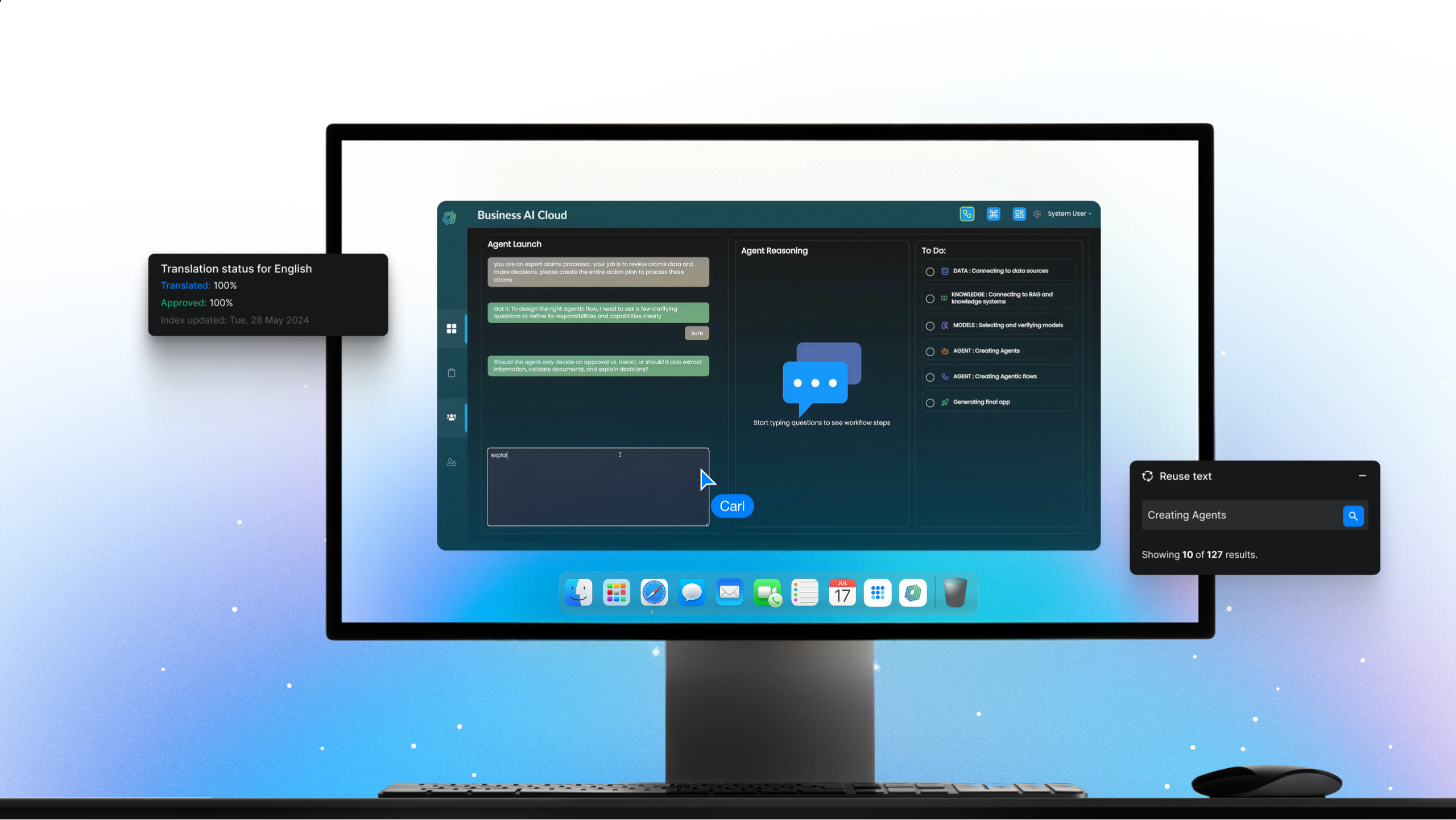
Uniphore is an enterprise-grade AI software company. It builds agentic AI, data orchestration, and automation platforms specifically designed to help organizations manage and improve customer service, sales, and marketing. Uniphore created the Business AI Cloud platform, which unifies enterprise data, AI models, and automated software agents to execute complex, real-world business tasks.
Robert Perry, Manager of Technical Documentation, shared the story of Uniphore’s transition from unstructured authoring chaos to a unified content architecture across a consolidated product portfolio.
The Challenge of a Multi-Tool, Unstructured Authoring Environment
The Uniphore technical documentation team consists of 6 experienced technical writers spread across the globe. The team is responsible for documenting an expanding portfolio of AI-mature products and platforms across multiple delivery channels and product versions, as well as a growing help center ecosystem that supports both customers and internal stakeholders.
Before using Paligo, the team used a variety of disconnected authoring tools, including Word, Confluence, Adobe RoboHelp, and Zendesk, each with a different content development process. Content duplication across product lines was an issue, as a single shared concept might exist in three to four slightly different versions. Perry said that changing one meant hunting down and manually updating every instance, with no guarantee of consistency.
The product environment became more complex due to rapid product growth and acquisitions, introducing additional content repositories, authoring platforms, and documentation standards.
The result was a fragmented content ecosystem with multiple standalone product help sites, inconsistent content structures, and no single source of truth. All of this created challenges for reuse, governance, consistency, and maintenance.
The time and labor it took them [the tech writers] to update and keep different product sets updated and accurate was laborious, so the benefit of using Paligo is immeasurable.
The Hunt for a New Authoring Tool
The team knew the tools they were using were more suited to collaborative knowledge sharing and knowledge bases, not for structured technical documentation. So they set out to develop a global solution that would unify existing content development and enable rapid scale-up. The solution included acquiring an authoring tool for use by everyone.
The project’s goals were straightforward. They wanted to consolidate fragmented content into a single library, establish a reuse architecture that enabled shared concepts, and maintain a consistent visual and contextual format for all content to promote cohesiveness in the product line. The team also wanted to align documentation release cadences with engineering sprints to ensure the Help Center was always up to date the moment a product ships.
Together, the technical documentation and product teams developed requirements for a new tool that would empower the team to create, maintain, and publish documentation in a timely and efficient manner. This new tool had to provide:
- Structured, topic-based authoring, aligned with DITA principles
- Content reuse across publications
- Robust version management to handle simultaneous documentation tracks for multiple product releases without conflicting edits or branching nightmares.
The search process included several different tools, but the selection team settled on Paligo CCMS for a few primary reasons:
- Paligo CCMS is a cloud-native CCMS with zero infrastructure overhead and no IT dependencies, making it easy to support a global writing team.
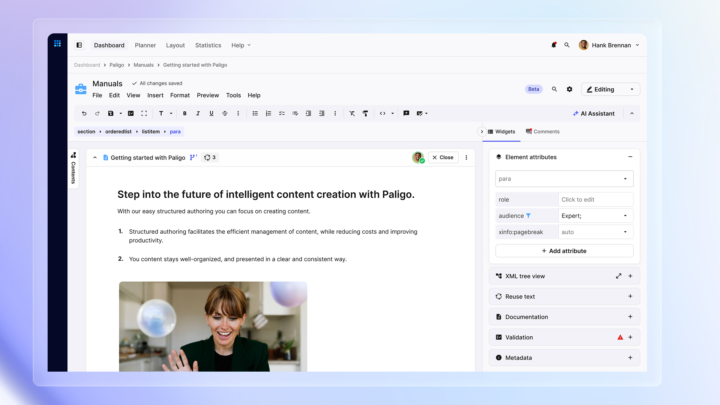
- Paligo’s structured authoring model provided the benefits of reuse through profiling and variables, without the writers needing to know how to author XML, leading to a dramatic decrease in content duplication and inconsistencies across documentation.
- Native integration with Zendesk enabled direct publishing to the Help Center at the time, with a single click, eliminating hours of reformatting work for writers on updates or releases.
Although the team lacked extensive experience with structured authoring, they picked it up quickly with the help of Paligo.
Paligo’s ability to organize content into discrete, reusable topics while maintaining product-specific publication maps provided the architecture we needed to consolidate all our product content libraries without losing the ability to publish product-specific outputs.
How Paligo Supports an Improved End-to-End Documentation Process
The Uniphore technical documentation team uses Paligo strategically. Key features such as structured authoring, single-sourcing, and topic reuse across products are used daily. The team also extensively uses conditional profiling and variables in their content to promote consistency across publications.
Before using Paligo, publishing content to their Zendesk Help Center required manually reformatting and uploading all content for each update or release, which sometimes took hours. With Paligo CCMS, they were able to integrate Zendesk natively and publish content in minutes with a single click.
This is a very meaningful cognitive and workflow shift, as we now think in terms of reusable components rather than monolithic articles. We also thought about how the content is shared across the product lines, and items went from being duplicated and independently maintained to being authored once and reused, so write once, use often. And our version and release management became structured, thankfully, so instead of tracking changes across product lines informally, we adopted formal version management with content tied to each specific product version with clear branching and release control.
In addition, the team leverages Paligo’s global collaboration and review capabilities. With between 60 and 80 documentation reviewers, the team was able to get all reviewers working in Paligo rather than sending PDFs, Word documents, or email updates, improving and speeding up the review process.
Overall, the team was unanimously supportive of using Paligo CCMS. It fundamentally changed how the team operates, moving from an unstructured, tool-diverse environment to a purpose-built CCMS and a single set of documentation standards.
The move to Paligo gave us the architectural foundation to scale our documentation alongside our product portfolio that continues to grow in complexity with every release.
Since implementing Paligo CCMS, they have used Paligo to manage all of their content across three Help Center migrations, including their current custom S3 site, which uses the HTML5 help center template in Paligo. The team can also produce PDFs for customer-facing release notes and reference guides. Because Paligo supports multi-channel publishing, the team can easily publish consistent, accurate documentation to different channels and formats in minutes, not hours or days.
Ensuring Documentation is AI-Ready
Uniphore is at the forefront of AI, so the documentation team understands the need to create and manage content that works not only for humans but also for AI.
As an AI-focused company, we appreciate that Paligo enables the creation of AI-ready structured content, recognizing that structured, semantically rich content improves AI readability, reusable components create cleaner AI grounding, and metadata-rich docs reduce hallucinations. We realize that our output is consumed by both AI systems and humans, and we strive to treat our content as our AI infrastructure. So, with Paligo, our team continues to build the foundational content that powers our AI-driven initiatives and offerings.
Start by Getting Educated
Perry’s advice to other documentation teams is to learn the basics of structured authoring before selecting a tool. By educating yourself first, you will know exactly what you are looking for and how it will help you in the long run.
Probably the most important thing is to recognize that the content architecture decisions that you’re going to make at the beginning compounds over time, so you’ve got to get the right tool in place. So, getting your structured authoring right with proper reuse, versioning, and output management will pay dividends in the long run. Paligo made it practical for us to build that architecture without requiring a team of specialists or IT engagement. We also are a very lean team, so that combination of structural rigor and operational accessibility was what made Paligo the right choice for us.