
What is Single Source of Truth (SSOT)?


How documentation teams stop duplicating content, cut translation costs, and ship consistent technical documentation across every product — from one authoritative source.
The short answer
Single source of truth (SSOT) is the practice of maintaining one authoritative version of every content component — a safety warning, a specification, a procedure — and reusing it everywhere it’s needed. When the source changes, every output updates automatically. In technical documentation, SSOT eliminates the “save as” workflow that causes version drift, duplicate translations, and release-day chaos. A component content management system (CCMS) makes this possible by shifting from document-based authoring to modular, reusable components authored once and published to PDF, HTML, mobile, and localized formats from a single source.
What is Single Source of Truth (SSOT)?
Let’s start with a real scenario. At Beijer Electronics, a global manufacturer of industrial automation solutions, the technical writer managed documentation for an entire portfolio — user guides, reference manuals, installation guides, release notes — across multiple product versions. All of it lived in large monolithic XML files built with Arbortext. Collaboration happened through email. The only way to publish was PDF via SharePoint.
When engineering found a specification that needed fixing, the question was always the same: which file is actually the right one? That question is the reason single source of truth exists.
DEFINITION
Single source of truth (SSOT) means maintaining one authoritative version of critical content and reusing that single component everywhere it’s needed — rather than copying it into separate documents. When the source component changes, every output that references it updates automatically. No hunting. No version conflicts. No wondering which copy is correct.
Think of it like a database record. Your CRM has one customer profile that powers email campaigns, invoicing, and reporting. SSOT works the same way for content: one component powers multiple deliverables. Update it once, and every dependent output reflects the change.
For technical writers, this is the antidote to “save as.” Instead of duplicating entire documents across product manuals, you create modular content components that are authored once and published to whatever outputs you need.
The Problem: Content Fragmentation in Technical Documentation
Nobody sets out to fragment their content. It happens gradually, through necessity and the limitations of file-based tools.
You finish a product manual. Next quarter, a new variant launches. Rather than starting from scratch, you do what any sensible person would: create a copy, edit for the variant, move on. Then another variant. Another copy. Six months later, five versions of the same safety warning sit in five different files — and nobody’s sure which one was updated last.
Then engineering discovers a flaw in a critical specification. The panic sets in two hours before the deadline when someone finds the warning was updated in three manuals but not two others.
Which version is authoritative? How do we make sure all copies get updated before the release deadline?
— The question every documentation team dreads hearing at 4 PM on a Friday
The localization team faces an even worse version of this. They’re translating the same content in dozens of separate files. Multiplied costs, multiplied review burden, plenty of opportunity for terminology to drift between products.
And underneath all of this: nobody actually knows which version is authoritative. Writers work in silos. A subject matter expert might approve a specification in one manual, completely unaware it’s been copied into twenty others.
WHY THIS MATTERS BEYOND EFFICIENCY
Content fragmentation isn’t just a time problem — it’s a compliance risk. In regulated industries like industrial automation, medical devices, and aerospace, inconsistent safety information across documents can create genuine liability. SSOT eliminates this by ensuring every instance of critical content is inherently synchronized.
How Single Source of Truth Works in a CCMS
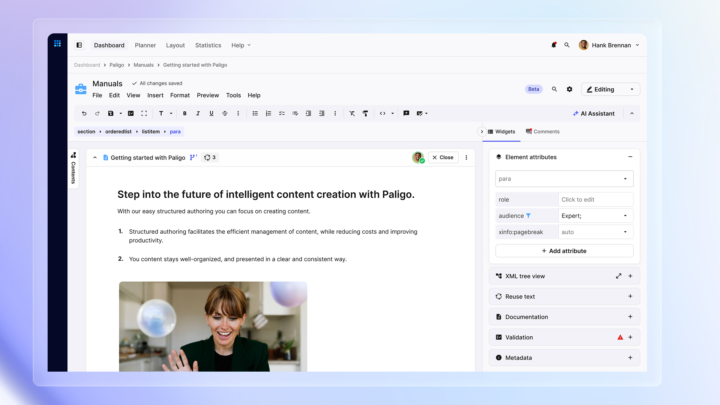
SSOT isn’t just a nice idea — it’s a practice that requires specific tooling. A component content management system (CCMS) makes it possible by shifting from document-based authoring to component-based authoring.
Instead of writing in monolithic documents, you author modular reusable components. Each one is versioned, stored centrally, and — critically — referenced by documents that need it. Not copied. Referenced.
THE KEY DISTINCTION
True SSOT uses reference-based reuse, not copy-based reuse. Documents don’t contain copies of components — they point to them. The reference is resolved when you publish. Update the source, and every document reflects the change automatically. That’s the difference between SSOT and “save as.”
Here’s how it works: you create a component — “Thermal Specifications for Product X.” When Product Y launches with identical specs, you don’t copy the component — you reuse it. Update once, both manuals reflect the change.
Structured Authoring and Content Reuse — Deep dive into component-based architecture
A CCMS also gives you version control (like Git for content), variant management for conditional content, and multi-channel publishing to PDF, HTML5, mobile, and eLearning — all automatically.
Single Source Publishing — Multi-channel output strategies
Real-World Example: How Beijer Electronics Made It Work
CUSTOMER STORY
How Beijer Electronics achieved 73% topic reuse across 463 publications — from fragile monolithic XML files to structured content with 53 active contributors.
73%
Topic reuse
463
Publications
18%
Image reuse
53
Active Reviewers
Where They Started
Beijer Electronics makes industrial automation and connectivity solutions. Their documentation was managed by a single technical writer using Arbortext for file-based authoring. Content lived in massive XML files with unreliable profiling. Email was the only collaboration channel. PDF via SharePoint the only delivery format.
What Wasn’t Working
The files were fragile. Even minor updates were time-consuming and risky. One XML error could break an entire publication.
Collaboration was a dead end. Engineers who spotted errors had to email the writer and wait. The process was so slow people stopped reporting issues.
One person held all the knowledge. A single writer with years of domain expertise — massive ramp-up risk if they left.
Nothing was reused, so nothing was consistent. Copy-paste meant branding, voice, and terminology drifted. Customers noticed.
What They Changed
Beijer moved from Arbortext to structured, topic-based content in a CCMS. They launched an HTML5 documentation portal alongside PDF, integrated single sign-on, and connected translation workflows for eight languages.
Most importantly, they brought product owners and engineers into the content workflow as active contributors. Technical writers shifted from sole authors to editors and quality gatekeepers.
Product owners take visible pride in their documentation. Engineers and reviewers contribute through inline comments instead of email chains.
— Petter Bergeling, Beijer Electronics
The Results
73%
Topic reuse
463
Publications
18%
Image reuse
8
Languages
Multi-channel publishing from one source — PDF and HTML5 portal from the same content. Same-day turnaround on reviews. Translation consolidated across eight languages.
THE PART NUMBERS DON’T CAPTURE
Writers gained confidence updating content without fear of breaking files. The support team shared direct links to documentation sections instead of emailing PDFs. Documentation went from afterthought to a product asset people were proud of. 53 reviewers actively contributing — compared to near-zero before.
Benefits of Single Source of Truth
What the Organization Gets
Faster Publishing Cycles — Modular content means assembling manuals from components. A variant that took 6 weeks can be done in 2. Beijer publishes 463 publications from a single source.
Reduced Translation Costs — 73% topic reuse means translating each component once, not per product. Across eight languages, the savings compound significantly.
Consistent, Accurate Outputs — One source, no drift. Critical for safety-critical information where inconsistency creates liability.
Improved Compliance — Full audit trail by default. Compliance reviews become faster and more reliable.
What Writers and Teams Actually Feel
Confidence Before Every Release — The “did I miss updating one copy?” panic goes away.
Shared Ownership — Product owners writing their own content, 53 reviewers engaged. Documentation stops being one person’s burden.
Less Busywork, More Craft — Version-conflict friction removed. More time for writing clear, useful content.
Documentation Earns Respect — Support sends direct links. Product managers reference it in sales conversations.
When SSOT Makes Sense (and When It Doesn’t)
We’d be doing you a disservice if we pretended SSOT is always the answer. Here’s an honest assessment.
Worth the Investment When:
- Multiple products share specs, procedures, or safety info
- Regulated industries need traceability
- Frequent releases mean constant updates
- 3+ languages make duplication expensive
- Long support lifecycles extend maintenance over years
Probably Overkill When:
- Single product, single manual — no reuse opportunity
- Narrative/creative content needing unique voice
- Very simple documentation (5-page quick-start guide)
- No localization requirements
- Team not ready for CCMS adoption
SSOT vs. Copy-Paste Content Reuse
This distinction matters more than most people realize — and it’s where teams fool themselves into thinking they already have SSOT when they don’t.
| Aspect | Copy-Paste Reuse | True SSOT |
| How it works | Content copied into new documents | Documents reference a single source |
| When source changes | Copies NOT updated — manual hunt | All references update automatically |
| Over time | Copies drift apart | Consistency enforced by design |
| Translation | Translate every copy separately | Translate each component once |
| Audit trail | No traceability across copies | Full version history per component |
| At scale | Breaks down | Designed for it |
This was the heart of Beijer’s transformation. Old workflow in Arbortext: copy-paste. New workflow: reference-based SSOT. That shift enabled 73% topic reuse across 463 publications.
Implementing SSOT: Key Considerations
Content Architecture First
Before choosing a CCMS, figure out your component taxonomy. Which content types should be reusable? Map the dependencies. This audit is often as valuable as the implementation itself.
Choose Tools That Connect
A CCMS needs to integrate with your localization vendor, publishing pipeline, and review workflows. A cloud-native CCMS like Paligo provides authoring, version control, conditional publishing, and multi-channel output in one system.
What is a CCMS? — Understanding component content management systems
Invest in People, Not Just Software
Beijer succeeded by lowering the barrier to contribute, not raising it. 53 reviewers engaged because participation became easy, not mandatory.
Single Source Publishing — Team adoption strategies
Start Small, Prove It, Expand
Pick your highest-reuse product line. Implement SSOT there, measure, then expand. A pilot gives proof points and surfaces challenges early.
THREE THINGS YOU NEED
Every successful SSOT implementation has: (1) a clear content architecture and component taxonomy, (2) tooling that supports component management and multi-channel publishing, and (3) genuine investment in team training and workflow change. Skip any one, and the project stalls.
SSOT and Localization: Translation Cost Impact
Localization is where the financial case for SSOT becomes hardest to argue against.
A 100,000-word documentation suite at €0.10/word costs €10,000 per language. If 40% is duplicated, only 60,000 words are unique. That’s €4,000 saved per language, per release. For eight languages with quarterly releases: €128,000 in annual savings.
40%
Typical duplication
€128K
Annual savings (8 langs)
1×
Each component translated once
Beyond cost: SSOT dramatically improves translation memory efficiency and eliminates terminology inconsistency. Beijer consolidated eight languages in one system.
Content Reuse Strategy — Comprehensive guide to building a reuse framework
Getting Started with Single Source of Truth
If you recognize your own situation in this article, here’s a practical path forward.
Step 1: Audit Your Duplication
How much content is duplicated? What does it cost in translation, maintenance, and rework? If duplication exceeds 30% and you localize into multiple languages, the math favors SSOT.
Step 2: Map Your Component Taxonomy
Which products share which content? Where do they diverge? This clarifies your roadmap and gives you numbers for the business case.
Step 3: Evaluate CCMS Options
Look for component versioning, multi-channel publishing, localization integration, and ease of use for writers — not just administrators.
Step 4: Run a Pilot
Pick one product family. Implement SSOT. Measure reuse rates, time saved, and translation impact. Use those numbers to justify expanding.
Step 5: Train the Team — Then Lower the Barriers
Make it easy for people to participate. Beijer’s success came from reducing friction for contributors — not adding process.
Frequently Asked Questions
What’s the actual difference between SSOT and single-sourcing?
They’re closely related. Single-sourcing means authoring once, publishing to multiple outputs. SSOT emphasizes one authoritative version everything references. In practice, if you’re doing single-sourcing in a CCMS, you’re doing SSOT.
Can’t I just do this in Word or Google Docs?
You can try, but you’ll end up with copy-paste reuse, not true SSOT. Word and Docs don’t have component referencing or multi-channel publishing. The “save as” problem will come back as soon as you scale.
How long before we actually see results?
Pilot: 2–3 months. Full rollout: 6–12 months in phases. The content audit and taxonomy design — the part that makes everything else work — typically takes 4–8 weeks.
What if our team doesn’t want to change how they work?
This is the hardest part — harder than the technology. Success comes from making the new workflow easier, not harder. Beijer got 53 reviewers engaged by lowering barriers: SSO, inline commenting, and giving people ownership.
We’re in a regulated industry. Does this actually help with compliance?
This is where SSOT is strongest. Any industry needing version history, approval trails, and provably consistent safety information. A CCMS-based SSOT provides audit capabilities by default.
What about content that’s almost the same but needs small tweaks?
That’s what conditional content and variants handle. One component with rules: “Show this for EU markets,” “Use this spec for products after Q3 2024.” One source, multiple controlled variations.
Do we have to migrate everything at once?
No — and you shouldn’t. Start with your highest-reuse content. Prove the value. Then expand. Gradual rollout reduces risk and lets the team build confidence.
Is this just a way to sell us a CCMS?
SSOT is a methodology, not a product. You need a CCMS to implement it properly, but the principle — one authoritative source, reused everywhere — is what matters. We wrote this because we’ve seen the difference it makes. If our CCMS is the right fit, great. If another tool works better, that’s fine too.
About This Guide
Paligo Content Team — Technical Documentation & Content Strategy
This guide was written by Paligo’s content team, drawing on direct experience helping organizations like Beijer Electronics transition from file-based authoring to structured content management. Paligo is a cloud-native CCMS used by documentation teams across industrial, medical, and technology sectors.
Fact-checked and verified: All statistics come from Paligo’s published customer case studies. Last reviewed: March 4, 2026.
Ready to explore content reuse? Book a demo to see how Paligo handles SSOT in practice.
Content Reuse Hub — Complete guide to content reuse, single-sourcing, and CCMS
Stay ahead in structured content
Get the Paligo Pulse once a month.

Share
Author