Paligo’s Next Gen Editor is Redefining the CCMS Experience

Structured content has changed how documentation teams scale. But the editors – where content is actually created and reviewed – haven’t kept pace.
Complex interfaces and fragmented review workflows push subject matter experts (SMEs) back to PDFs and email threads.
Paligo’s new editor closes that gap: a modern, intuitive editing experience which keeps the full power of structured content.
A Story: When Documentation Collaboration Breaks Down
Max is a technical writer updating documentation for his company’s next product release.
Jennifer is a Contributor with subject matter expertise. Together, the two need to get the documentation updated before launch, and the timeline is tight.
Max has made a number of changes to the documentation in the CCMS (component content management system). He now needs Jennifer to review and make any edits necessary. Plus, she has some additional sections to add, but isn’t sure where they should go.
Jennifer logs into the CCMS and tries to make her changes, but the editor feels nothing like the writing tools she uses every day. Frustrated, she gives up, exports a copy of the documentation as a PDF, marks it up with changes, noting where the new sections should go, and gives Max the new content to add.
Max now needs to review the PDF, identify the components to update in the CCMS, add the new sections, and enter the new content manually. When he copies and pastes Jennifer’s content – a list and an image – into a new component, the formatting breaks. The entire process takes twice as long as it should, and the risk of missed updates or broken content is real.
This story plays out on documentation teams everywhere. CCMSs were built to enable structured authoring and better collaboration – but the editing experience hasn’t kept pace.
Paligo is changing that.
The CCMS Promise and the Time-to-Value Gap
Technical documentation powers AI applications like support chatbots and product knowledge bases – and the quality of that documentation directly shapes the quality of the answers. To keep up, teams are turning to a CCMS. The promise is clear: structured content, managed at scale, ready for every channel. But there’s a gap between that promise and how quickly teams can actually deliver.
A CCMS enables structured authoring and content reuse, reducing what writers need to create and manage while giving AI a reliable source of truth. Knowledge becomes a database of single-sourced components, not a scattered file system. That foundation supports translations, multi-channel publishing, and the grounding layer for trustworthy AI.
But the editors in most CCMS platforms are still too complex for writers new to structured content – and even harder for SMEs who simply need to review and approve.
A CCMS solves the scale problem, but it has left everyday authors, contributors, and reviewers behind.
Why The Editor Became the Bottleneck
Before building the new editor, Paligo listened closely to what customers were struggling with, and rethought the experience from the ground up.
Many customers are new to structured authoring, or XML, and find the editor poses a steep learning curve. For SMEs and other non-technical authors who also want to create or review content, the editor lacks the familiar, intuitive design of the word processing tools they use regularly.
The existing editor made onboarding difficult and pushed even experienced users into clunky workarounds. The new editor needed to feel familiar from the first login – powerful, but never requiring specialized knowledge to get started.
Copy-pasting content – formatted text, images, lists – meant hours of manual cleanup. The new editor needed to handle rich content cleanly, so writers could bring in work from other tools without breaking it.
And the review process itself was fragmented: suggestions and comments lived in separate workflows, forcing teams out of the editor and into email threads or marked-up PDFs. The fix: a single interface where authors, contributors, and reviewers all work together.
Paligo didn’t patch the old editor. It redesigned the entire editing experience, modeled after the tools teams already use every day.
Redefining What “Modern Editing” Means for Structured Content
Structured content can’t stay locked behind XML expertise. As more teams depend on documentation – for onboarding, for AI, for scale – the people creating and reviewing that content need an experience that works for them, not just for specialists.
A modern editor for technical content starts by lowering the barriers to entry. Writers and reviewers should be productive from day one without needing to understand XML or content components.
But the editor isn’t just where writing happens. It’s where SMEs review and comment. It’s where non-technical contributors add content without breaking structure. And it’s where content becomes AI-ready.
The editor has to make structured content feel natural. Reading, editing, suggesting changes, incorporating feedback – none of it should require hours of training to use a complex platform effectively.
Paligo didn’t set out to build a better XML editor. It wanted to build a better content experience for every user.
But the editor isn’t just where writing happens. It’s where SMEs review and comment. It’s where non-technical contributors add content without breaking structure. And it’s where content becomes AI-ready.
The editor has to make structured content feel natural. Reading, editing, suggesting changes, incorporating feedback – none of it should require hours of training to use a complex platform effectively.
Paligo didn’t set out to build a better XML editor. It wanted to build a better content experience for every user.
Designing an Editor for How Teams Work
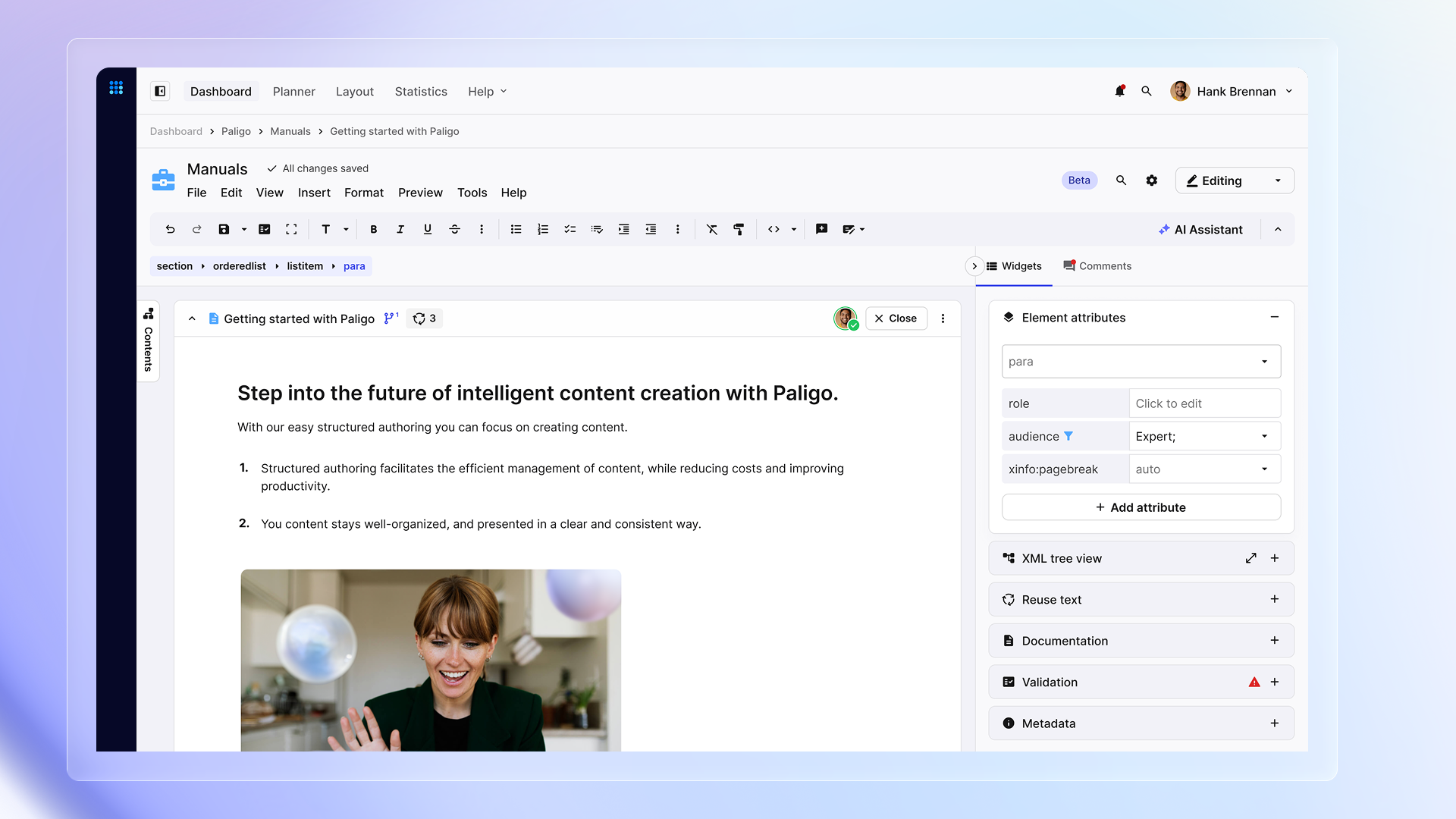
The next-generation editor in Paligo CCMS is designed to be efficient and reliable, removing the steep learning curves users faced around structured authoring and reviewing. It fundamentally improves how teams collaborate.
One view, full context
Authors and Contributors can now view the entire publication in a single view and select components to edit. Reviewers continue to see the full publication and can add comments.
The experience is modeled on familiar word processing tools everyone already knows. The content stays fully structured underneath, but reviewers never need to think about that.
Inline suggestions and comments without context switching
Previously, Authors had to open a separate editor to select and modify a component. So, they would see comments in one view and need to switch to another view to make the required changes. Now, they work within the full publication in the new editor, viewing comments and making changes without ever switching views.
Suggestions appear directly in the content – additions, edits, and deletions are all visible in context. Authors accept or reject each suggestion, and threaded comments keep the conversation alongside the content.
Eliminate the copy/paste nightmare
The new editor can handle the most complex rich content, speeding up the time it takes an Author to create and update content. Authors and Contributors can paste new content exactly where it belongs – with the formatting intact.
Back to Jennifer and Max: collaboration without friction
So how does this change things for Max and Jennifer?
Jennifer receives a link, opens the publication, and sees the entire document in a single view. She scrolls through the content, finding exactly what she needs to review and edit.
When she sees something that needs to be changed, she can use the suggestion tool to update the text. In some cases, she only wants to add a comment, which she can easily do from the same interface. Max can also now use the suggestion and comments tools within the editor.
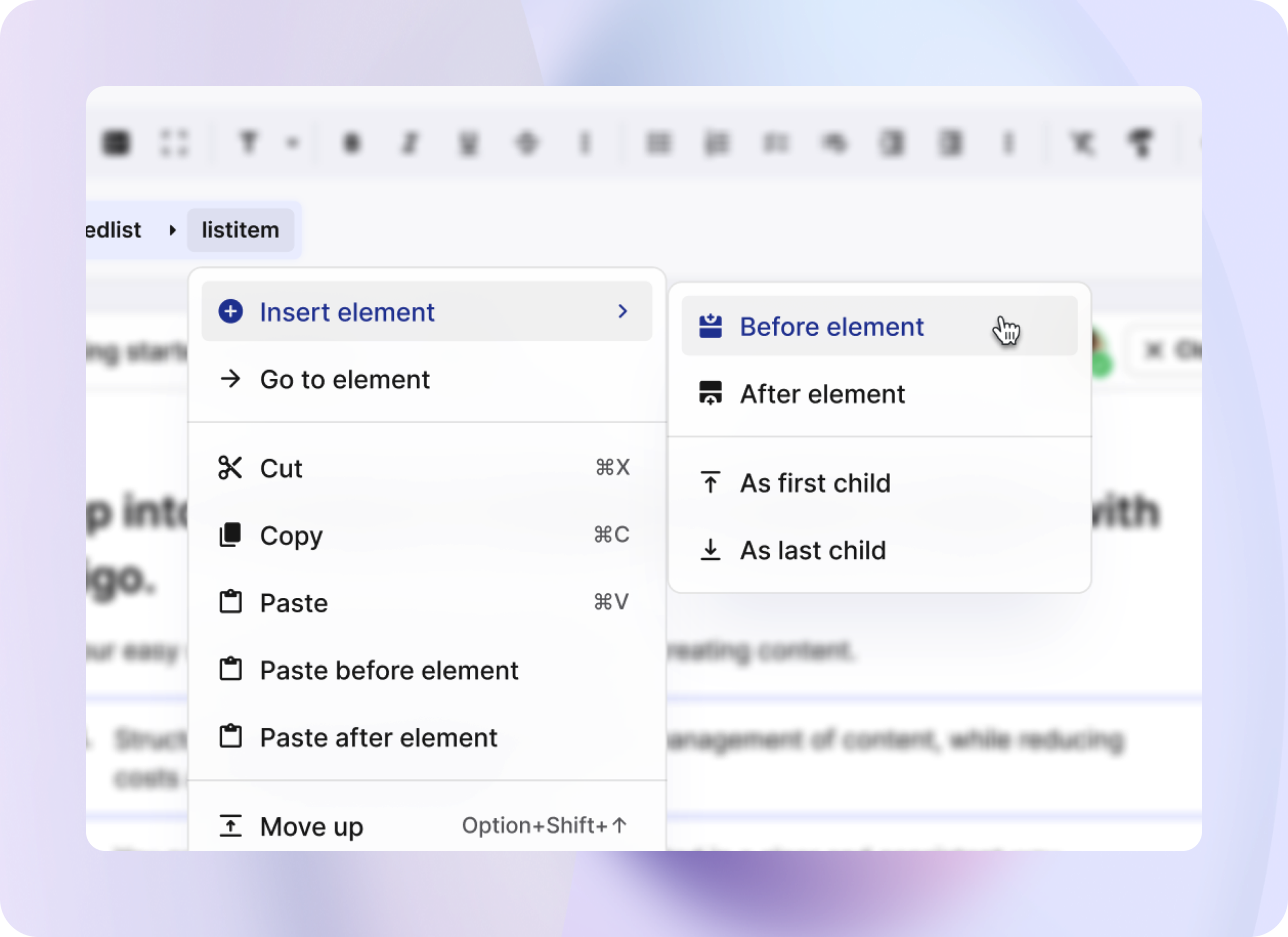
As for the new sections she wants to add, both Jennifer and Max can now move to the location they want to a section and add them via a button in the toolbar.
Jennifer and Max now work in the same interface – creating, reviewing, and publishing from one place. It’s a remarkably faster and more reliable way of working.
Beyond a Better Editor: Building the Right Foundation
The new editor solves one of the biggest trade-offs in the component content management industry: powerful structured content versus modern collaboration.
Everyday writing and productivity tools are very good for collaboration, enabling multiple people to easily work on new content. But they do it at the expense of structure. These productivity tools generate unstructured content that can’t be reused without copying and pasting, leading to duplicate content that is hard to manage and govern.
Then there are tools, like some CCMS or XML Authoring tools that offer robust, XML-based structured authoring, but at the expense of collaboration. In some tools, there are completely separate interfaces for creating and reviewing content, resulting in what’s known as the “two UI problem.” Some use desktop tools to create content and send it for review in PDF format.
Paligo’s new editor delivers it all: structured authoring with built-in review and collaboration, while building the core knowledge infrastructure for the future.
Structured Content as Infrastructure for AI
Most CCMS providers bolt AI features onto old architecture. Paligo took a different path: rebuild the foundation first, then build intelligence on top.
You can’t build the future of content on yesterday’s authoring experience. – Rahul Yadav, CEO at Paligo
This new editor isn’t just a better XML authoring tool. And it’s not another bolt-on AI writing assistant.
Paligo is building the infrastructure first: a single, intuitive experience for every type of user, designed to integrate AI features seamlessly and securely.
They are building a platform that enables writers to create content faster and empowers SMEs to participate consistently. Documentation is created, reviewed, approved, and published to multiple channels faster, without compromising content quality or accuracy.
Customers depend on documentation to use products, answer questions, and troubleshoot problems. That’s the baseline.
But documentation now serves a second purpose: training data for AI applications and agents. Structured, accurate content gives AI reliable knowledge about how products work. Without it, hallucinations and inaccurate answers follow – a risk no organization can afford, especially in regulated industries.
What Comes Next
The new editor in Paligo CCMS isn’t just an interface update. It’s a deliberate shift in how structured content is created and sustained over time.
By unifying authoring, reviewing, and collaboration in a single, intuitive experience, Paligo removes one of the biggest barriers to effective documentation: friction between people, tools, and structure. Writers work faster. Reviewers stay engaged.
For content leaders, the impact goes beyond a workflow. A familiar editing experience means shorter onboarding cycles and less time spent on training. When contributors and reviewers can work confidently from day one, adoption stays high – and teams spend their energy on content quality, not platform friction.
And this foundation matters. High-quality, easy-to-use structured documentation isn’t only critical for customers – it’s essential for training reliable AI systems and agents. Without it, speed comes at the cost of accuracy and trust.
Improving the editor is just the beginning. Paligo is building an AI-native infrastructure that allows documentation to scale, adapt, and power what comes next.
Get started with Paligo
Paligo is built to meet the most demanding requirements, with plans made for any company from the growing SMB to the large Enterprise.
Stay ahead in structured content
Get the Paligo Pulse once a month.

Share
Author