
How XTM Scaled Documentation with 5,000 Topics and 73% Content Reuse

Managing documentation for global software products is complex. Multiple versions, frequent updates, and growing feature sets quickly overwhelm traditional tools.
For XTM International, documentation once lived in a single 500-page Word document distributed as a PDF. As the company expanded its product offerings and acquired new businesses, that approach could no longer keep pace.
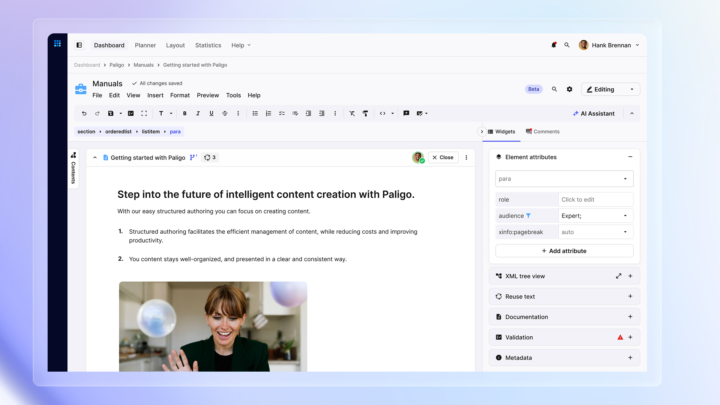
By adopting Paligo’s component content management system (CCMS), XTM built a structured documentation platform with over 5,000 topics and more than 73% content reuse, dramatically reducing the time required to manage documentation across products and versions.
From a 500-Page Word Manual to Scalable Documentation
XTM is an AI localisation and translation platform built for enterprise teams to globalise content, products and experiences at scale.
Composable by design, XTM enables organisations to adopt the capabilities they need now and extend over time across translation management, software localisation, localisation operations and business management, multimedia localisation, and integrations through a growing connectors ecosystem that plugs into existing systems.
XTM helps global teams automate translation, improve linguistic quality and gain full visibility across multilingual content workflows. Advanced AI, including AI agents, streamlines project execution, improves translation accuracy, supports quality scoring and reduces manual effort across complex content environments.
With robust workflow management, vendor and financial control, and deep integrations into the tools where content is created and delivered, XTM enables organisations to scale global content operations with speed, transparency and governance.
Trusted by over 1,300 organisations worldwide and supporting more than 900 languages, XTM helps businesses run localisation as a measurable, data-driven function that accelerates global growth.
Six years ago, XTM had one core product, XTM Cloud, with some add-ons and connectors. At the time, the documentation process consisted of one person documenting product features in a Word document. The Word document was then saved as a PDF and linked from the product user interface (UI) for users to download.
Sara Basile, Director of Platform Product Management, said that documenting in Word wasn’t scalable. There was a lot of manual effort writing and rewriting the same content in one large Word file (at one point, the document was 500 pages). It was difficult to navigate the large PDF, even with bookmarks and built-in sorting.
Agnieszka Przysiuda, one of two technical writers for XTM, added that they had no control over who was using which version of the PDF. Once a user downloaded a copy to their desktop, there was no way to know if that user was checking for updates or new versions, or would continue to use the version they downloaded.
The lack of a suitable authoring tool was one of the main reasons XTM decided it was time to explore products. At the same time, SaaS companies were using web-based tools to write and deliver documentation to customers, and Basile said the company felt it should follow the same approach. Basile also explained that XTM believes that user documentation is a driver of website traffic and lead generation.
The company started looking at pure authoring tools, such as Oxygen, but quickly realized that what they needed was more than just an authoring tool. They also needed to manage components, reuse content, and have more control over the publishing workflow. They wanted one product to support the entire documentation process.
Choosing a Platform Built for Structured Content
The documentation team was just getting started and wanted a good set of functionality, but didn’t want to overcomplicate the process. XTM reviewed several tools and selected Paligo because it was the right fit in terms of complexity.
Price was another important factor, with Paligo providing the best price-to-value ratio. Basile also said they had a very good support experience and felt they had better relationships with teams that respond quickly and transparently, like Paligo.
We felt like we found a good partner.
Building a Documentation Foundation for Growth
The first step wasn’t implementing Paligo. It was restructuring the documentation. They chose not to use the import capabilities for the initial setup, instead spending time upfront restructuring the documentation and designing a proper information architecture.
We spent a lot of time defining what do we mean by topic? What do we mean by component? How do we envision reusing these components? What are the requirements from a reusability, and from a publishing perspective? We were trying to think two, three years ahead of what we might need from an XTM product perspective, and how the product would evolve, and how this would translate into documentation requirements.
XTM acquires companies to add capabilities to its portfolio, and each company uses different tools and has its own source of truth for product documentation. XTM wanted Paligo CCMS as its single source of truth. So, with every acquisition, they import that company’s documentation into the CCMS.
Technical writer, Oksana Vishchuk, joined the company as part of one of these acquisitions and explained that, in her case, the content was created and managed in Confluence. The import function was used to migrate this content into Paligo via Word, but the CCMS already had a lot of structure in place, so the process was smoother.
The team learned about structured authoring and using the CCMS through online training and documentation. Basile said the self-service training was a great way for the team to get up to speed quickly and independently.
How XTM Scales Documentation with Reuse and Versioning
Vishchuk and Przysiuda are the primary users of Paligo CCMS, spending between three and five hours a day working in the product, on average. Their favorite features revolve around topic reuse, versioning, and collaboration.
Managing Multiple Product Versions Without Duplicating Content
Przysiuda explained that she manages the documentation for XTM Cloud, XTM Portal, and the Business Intelligence Dashboards, and versioning is a feature she uses the most. She manages multiple versions of a product’s documentation without duplicating topics and often assigns paragraphs to specific versions.
Write Once, Update Everywhere
Topic reuse is another key feature, with both Przysiuda and Vishchuk saying they can easily make changes to a topic and have those changes reflected everywhere the topic is used across the documentation set, including across versions. To create a new version, Przysiuda simply creates a copy of the entire publication and then adds new topics or deletes deprecated ones. She regularly reuses text fragments, such as admonitions, paragraphs, procedures, and steps.
Screenshots and inline icons are also reused, and Vishchuk noted that the ability to bulk upload images and then update them across all publications is very helpful.
Variables are another key feature used in the XTM documentation. Variables are created for product names, connectors, and add-ons, making it easier to change names (which often change with third-party products).
In all, there are 5,000 topics in XTM’s CCMS, with 73.3% topic reuse, 37.4% media reuse, and 4% text fragment reuse.
Keeping Terminology Consistent Across Documentation
Paligo CCMS includes a Glossary, which the XTM documentation uses. The team likes that you can create a glossary term, highlight it in the documentation, and link it to the Glossary definition.
Bringing Writers and Reviewers into One Workflow
The technical writers use Paligo CCMS collaboration capabilities to support review and approval workflows. There are 19 reviewers, some more active than others. The writers create new assignments in the CCMS, and reviewers are notified via email or Slack to review the content. Both Przysiuda and Vishchuk appreciate that the review comments stay close to the documentation. The ability to archive or hide older comments was helpful in not overwhelming reviewers, as is the separation of comments from the actual documentation.
Delivering Web-Based Documentation at Scale
All documentation in the CCMS is published to a server via FTP integration, a process managed by the DevOps team, which also manages the website and online help. Documentation is published as HTML5 on the XTM documentation portal. There is a separate documentation portal for each product and version, and the web pages include automated links to subtopics.
Advice for Teams Considering a CCMS
There are many reasons a company would want to use Paligo CCMS, but Vishchuk and Przysiuda provided two key reasons they believe are essential: content reuse and versioning.
With these two features and the others mentioned above, XTM has achieved significant time savings, reducing documentation management from weeks to hours.