
Back to Paligo Academy
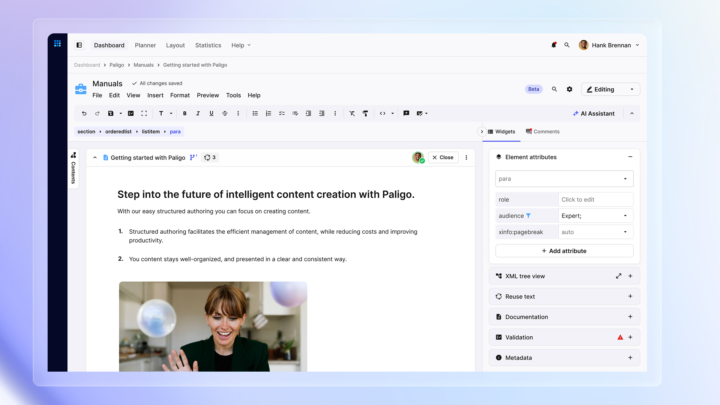
So everything we've done up to now has basically a parent. It's in the content manager. On the left, we can see it. We can reuse them in that way. Text fragments, by the way, text fragments are just another way of saying, anywhere we put text. So the most common element would be a simple paragraph, but it could be a title. It could be a caption in a figure. Any of these text pieces or text fragments can be reused anywhere, and we'll see in a second how we can use them. So let's go and have a look at one of our topics. Let's take a look at getting started. And we see that a paragraph here called 'the details are in the middle'. Let's say I wanna share that somewhere else. So one way I can do is let's go to 'a word from the owners'. Say, I want to put the sentence, reuse that paragraph here. So I go to reuse text. I'm looking for the text 'details middle'. And I'll search for that text by clicking enter. The result displayed by Paligo is one text fragment. And that is what we expected to see. If I want to see what it is, click on the gear icon and select usage information. And Paligo shows me where it's being reused and if I want to preview it, I want to open that topic, I can do all those types of things with it. I actually know where it is. So I want to reuse that paragraph. So what would I do? Let me click on the right place over on the left. Click on the text fragment I want to reuse. If I click on this one, insert content, no reuse, it's just like doing a simple copy and paste of the text. There's no linkage. They're not connected. I'll delete it. I don't want it. I could also have done undo. But if I click on the other option, reuse fragments, watch what happens. There's a little chain on the left hand side here alongside the text that shows it's being reused. And if I want to try to change something, I won't be able to. I'm gonna save it. Now this paragraph is being used in two places, how do I know? Well, I could go back here and have a look user's information. You can do the same thing for anything inside Paligo and from any element goes to the element menu and the same going for text and usage information. And as you've seen now, it's being used in two places: where I am now and where it was then. Let's say I want to make a change to this paragraph, but I'll just go in and try deleting. Paligo says I can't do that. And that makes a lot of sense because it would be dangerous to change in one place than the others, willy nilly, without actually, you know, giving you some sort of warning going to have to do some sort of action to do that. So what I can do though is then go to para and manually edit the reuse fragments. And I'll put the word Steve at the end and I'll save. So for a start, let's go back to that piece of content in getting started and we'll see if the text changed. And there you see, it's now become what was a normal paragraph has now become a reusable text fragment with the word Steve. And, a nice extra, I can go to text and show history, which you also do on the right side and watch this; I can actually compare between the old one and the new one. Click on compare and it tells me Steve has been added. If something had been removed, you'd see that as well. So we'll get into another session about general versioning. But just so you know, you can actually do versioning on every single text fragment paragraph caption title, whatever, right, inside the system. Nothing nothing to do with text reuse. Everywhere you can see, what have I done with this paragraph? Which can be really, really useful information as you're moving ahead trying to historically see what happened to the topic you're writing and editing. So that's quite simple. There's another way to do exactly the same thing. Let's say I want to copy this paragraph and use it somewhere else rather than going to reuse text, like I go to this paragraph, I could go copy. I could, for example, go into welcome, for example, go to the end, click on the section, and the same as before: insert and insert as reuse. If I do insert as reuse, that paragraph is now being reused there as well. Very simple. I can also copy and paste other elements, but I want you to understand the implications of doing so. So I want to reuse this list somewhere. So I could click on ordered list and I could go copy. And maybe think for a second, what do you think's gonna happen when I paste in this list? Okay. You've had a quick thought. Let me show you. If I if I just go insert again, it just inserts it exactly that. That list is not reused in any way. I want to get rid of that, remember click on ordered list and delete. But if I go insert as reuse, it's being reused. But as you can see, all the paragraphs are basically being reused text fragments, reused paragraphs. So when I copy and paste that way, it's going to reuse those elements. A question for you guys to think about. If I want to reuse a list, how would I do that? This is obviously not a practical way to use one list as a whole. Which of the pieces of functionality would I use in Paligo if I wanted to create a list? Give you a couple of seconds to think about it. Let's have a look, shall we? Let's do it together quickly. Let's get rid of this list. What I would do, let's quickly go into topics, create content, and we'll go into, call it, and there's your answer, an informal topic and we'll call it a reusable... It's an reusable list. I'll open it. I'm not going to save. Set up topic. Maybe I'll just get rid of that para. I will go to the sidebar and so without reuse, there's my reusable list exactly like that. That's how I'd make a reusable list by pulling in a formal topic and just to prove it, if I go into welcome, I could go, for example, now at the end here, go into insert component. Let's just quickly find what we're looking for. Reusable list, but there's my reusable list. So my question was if I wanted to reuse that list, the answer was, put it into an informal topic. So you can find different things in the same way if I want to find a title as a text fragment. So I can go back to reuse here. I can write video about us, and you'll see there's our title which has come from here. And to prove it, usage information, and you can see it's checked out by me, which is this topic. For those of you who are not familiar with variables, they can play quite a central place in your architecture of content because let's say you've got two different products and you've got a welcome page, and the welcome page basically says, welcome to product A, welcome to product B. If you were in Word, for example, you'd have to have two separate pieces of content. In Paligo, by using a variable, we could have put a variable for the product name. Just use a single topic, just as welcome to the variable name and what we publish will say, okay, is it for product A or product B? So let's have a look at variables. They really can be very very useful for all different scenarios. The first thing we're going to do is to create a new variable set. So we go down. We have variable sets down here, and I'm gonna click on this button to create a new one. Create variable sets, and we'll call them recordings, which we're doing just now. Let's go down. I'll open it in a new tab. There we go. So this page shows all the different variables we're gonna have. Let's have a look how to do them. So add variable. So you have four different types. We have text which would be like your product name. Translatable text with the same thing, but in different languages with the translation export and in even send them to the translators and have them translate for you. There'll be more information on translations in a separate session. You can also have images if you've never thought of that before, let's say we've got this welcome idea, welcome to the so and so topic, and so and so product. So that would be a variable. Maybe on an image of the product underneath rather than having separate topics or complicated conditions, you could just put an image there as well. We'll see that in action soon. XML is more for inline elements, more than say for advanced use. So this we're going to call a product name, the first one. We'll add another variable here, an image, and we'll call that the product image. You can see a slightly different icon on the left. And my variance is essentially I'm gonna put in all the possible content that we're going to need. So I'm gonna have one variant here, which I'm calling product A. And I'll have another variant I add, you know, as many variants as you like called called another product. And into our just fill in all the possibilities. So we're going to call this some of the products I could've called it whatever I like and the same thing. And the product image. So we'll just imagine the image for another product is a car, and the image for another product for the product A is information that we need. Nothing to save, it's saved as soon as we press anything. Let's go and create a new topic where we can enter those variables. I'm gonna go to topics here, create content, and we'll call it welcome. And okay. I actually want to have this topic in a different tab. So rather than open it here, I'm going to right click on it and go open link in new tab. So I can have them both open if I want to. It's easy to open multiple topics or multiple components within Paligo in the same way. So I'm gonna put the variable in my title, 'welcome to', and let's put our variable in there. You could put in a paragraph. You could put it in a table, in a bullet, whatever you like. Insert, variable. I could search for the variable if I want down here, but I'm gonna go directly to recordings. And I want to put in the product name. So I'll click on it. So I can see the variable set, which is called recordings followed by the variable name. I just want to put a little bit more content in. So I'm gonna put a paragraph in. We like our own product. I want to put an image under this paragraph, so the same way we do a normal image, I'll just go to the next level there, which is right under the section in this case. And rather than go insert image and doing insert variable, let's go to recordings again and put in the product image. And if we see with the product image, it's got exactly the same elements as I normally have for a regular image image data, image object, and media subject. I could even set the width, like I can do for any image. And I'll set it to thirty percent, for example. And just to show a specific if I would like to, you can also put a variable image inside a text fragment inside a paragraph. If you remember, In the authoring video, we spoke about doing inline images, like putting an icon inside of there. So in the same way here, I can go insert variable, bring up the recordings again, and put in the image. And I have my content ready, very simple to do. I wanna show you something really useful. That we can preview your variables without having to do a full preview in a different window and all the different possibilities. So if I go to preview, and click on profile settings, it actually shows me a the possibility of seeing how this topic looks. So if I click on variables, and, you can see nothing is bolded until I get to recordings, because Paligo knows those recordings, in this topic, the variable. And I click on another product as one of the possibilities we have and click apply. We can see the title is updated, the inline image, and the full image below. If I choose rather another project, product a, the same thing. So I'm able to very quickly see the result of these variables. What can also be useful is if I go to favorites, I could save this. We'll just call it product a like that. If I click reset, but next time I jump in here, I could just set it and I can see my values immediately as a side point when we talk about collaboration, you can actually send an assignment out with this set already. So your SME, your subject matter experts in the collaboration view, they can actually see the content with the variables and profiling you need. I'm just going to move this inline image. So we'll click on inline image and click delete. And we'll click save. One more thing to show you in variables, which is also something relevant to all of Paligo. Let's say I want to see where is a variable being used, part of the the database behind the scenes. So if I go back to my tab where I had my variables, and I click I click on product name, I can go to usage information. This shows me where this variable is being used. And if it was used in multiple places, you'd see a list of multiple topics and components here. A really useful part of reusing your content is something that actually has three names all meaning the same, depending on where you come from on your history with with technical documentation, filtering, profiling, all conditions. What that basically means is let's say I've got a step or a paragraph or a full stop or an image or anything, that's useful in this topic, but not useful in the other. Well, I've got the same topic for managing users with one separate step of instructions for product a and product b. Why would I want to create a new topic? When the only difference are these small little differences between them. So be able to use filtering profiling or conditions, in order to do that, in order to reuse content even if there are small differences between the different instances. Let's get some content ready So we can actually play with the profiling filters or conditions. So let me just put some content in quickly so we're ready to go. So we've got some content in there. Let's go and condition that content. So if you see, I've got two paragraphs. One paragraph should appear just if you're beginners, and the other paragraph shall appear just if you're experts. So how are we gonna do that? So essentially going to use attributes. And we have lots of different subjects for attributes. So we're gonna do the three examples, subjects of audience, version, operating system, output format, market, country, etcetera, etcetera. Lots of different options you can find, a list of those in the help. Maybe it were different to a lot of the help authoring tools, where where essentially what I call intellectual gymnastics, trying to work out what shows and what doesn't. In Paligo, because of these different subjects, it's like telling a stories. In the end, I'll say, I want this to be for everybody, just version two, the Windows version for the UK market. And that's essentially how we publish telling that type of story. It's much easier than other systems you may have used in the past. So let's work on this one. So go to beginners. We want the para. I'll click on the attributes. There's a whole list of attributes that we've seen. The one that we want to take the first on the list just now audience. I click on audience. I have a whole bunch of values. These are values I've put in previously. You can put in your own here. If I just add value, just put in some nonsense for the time being and click okay, you can see there it appears. So you can choose your own values for any of these attributes we're going to go through. I'm just gonna delete it by clicking the x button and it's gone. So I wanna call this one 'beginners' and click apply. And you can see here the little filter alongside beginners with the audience of the value. If I wanted to change it, just click on here, and I'll be able to change it if I want to. Now if I click on experts, the same thing. So we go to the attribute. We go to audience. There's one called expert. So I've now got beginners and experts both using the audience condition or filter. So now we're gonna have a look at the second one, version two only. So if you're not using version two, we don't want our customer to see this this list, this list item in the final delivery. Now let's just notice. We have a para, and we have a list item. If I were to condition on the para, the list item would still appear. In other words, I'd have a number two with empty text. What I wanted is actually condition on the list item itself. I want the whole number to disappear. So when I go over here to choose which element want an attribute for always again as the same list here as I have over here, I want to click on the list item. And x info I'll look first. We have a whole bunch of attributes, additional ones I've added. For example, country market product and version. And not really very coincidentally. I have version two ready already, So I click on here. Click apply. So now I've set that list list item. You can see the filter is here for version two. A moment will not act checking, testing, publishing our content, we're just marking it up with the right conditions for when we want to publish later. So you can see we've done it at a paragraph. We've done it. As a list, we could've do at any level at a procedure level, the whole section, all different levels we can do. There's one extra level I'd like you to understand is what happens if I want a condition inside an existing sentence? A word, a phrase, a full stop or period depending on what part of the country you're located in. I still wanna offend anybody. So I'm gonna just select PDF here. I'm gonna do alt-enter, which brings up my list of elements, and there's something called phrase. So if you notice there's an extra element here in the structure called phrase, at the moment, there's nothing special about it. And you probably won't even define it to look differently. So nobody would know, but why do I want to do this? Because I've got this extra level, man. You see, phrase? So I can actually condition on that extra level called phrase. And there's one called output format. And this one is going to be for PDF. Again, you can add whichever values you like here. Let's do same thing for HTML so I'll go to the beginning of the HTML, select those four letters, alt-enter, put in a phrase. Look on the attributes, output format, and this one choose HTML5. So I've now marked up my content. Quite simple and quite logical. Now let's test. Like we've tested our variables on this live topic to see what's gonna happen with different scenarios. Let's do the same thing now. For previews, for for profiling. Let's do the same thing now for profiling. So let's click on preview. Profile settings again. This time, going into profiling. So Paligo shows you the profiles that I've used inside this same topic. Just as a a point of note, if you update something in the topic and you haven't saved it since or you've done it before, you might not need to press this refresh button. It just refreshes this list so it knows what's live and what's not live. I'm going to go to audience and choose beginner. I'm going to go to output format and choose HTML5, and I'll go to version, say version three. Apply. And you can see there that the content that hasn't been matched has been removed. I can even go a step further by going to options and hide unmatched elements. This is another way of saying. This is what it can look like when I actually publish and take a look. You can see that the number three has become a number two. PDF has been removed. Only HTML, and experts is nowhere to be seen. So I'm able to test this properly. There's something else that's worth knowing because maybe you'll do this for yourselves later or even in the collaboration side, I can actually save these options of profiling of variables that I've saved. So for example, let's say this one is version two, we call it 'beginners' we have the name. I can actually save this. So next time I can go and click it. So if I were to, let's say for example, reset everything and I go on to here, just clicked on it and you're seeing everything reset itself. So this also would be useful with collaboration because we can actually send assignments out to our reviewers and contributors ready with this content. So not every single one of your SMEs wants to see the information say for every product. They just want to see what's relevant for that SME for the assignments. And this is a way to really put the variables and profiling ready for them to see.
Apr 9, 2024