
Back to Paligo Academy
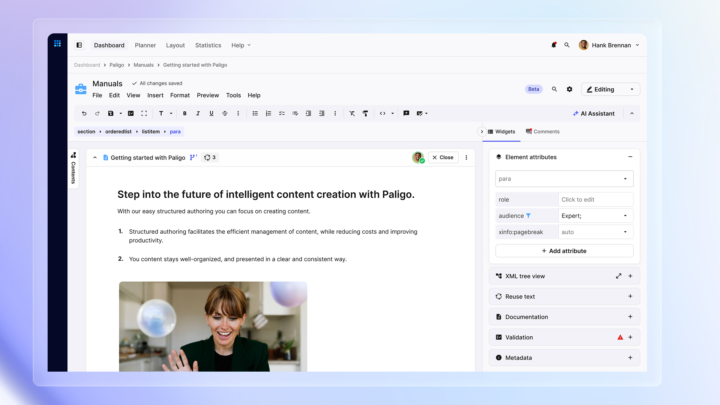
Welcome to this overview demo on Poliga. The Polygo CCMS or component content management system is a cloud based enterprise class system built for managing your full structured content workflow. It doesn't matter whether an experienced technical writer working in life science an analyst, whatever it may be. You'll be able to author your content, but not just author the full workflow, collaborate, get other people to contribute. Again, relatively simple to use. Translate the content if you need to. Advanced versioning. Publish out the different channels HTML PDF to scorm for e learning. The support platforms like Zendesk, and Salesforce. It's all there. So author in one place, reusable content, single source of content. A lot of those pains that you have just now as many companies do in rewriting the same content so many times, how to publish to different places, Well, within Polygo, it's all in one place. We can manage that process. Let me show you how. But let's discuss our Polygo solar system. A wonderful term. One of our team made up. This covers the different aspects, the different main pieces of functionality that Pulego can help you with. With the authoring, the reuse, versioning, collaboration, translation process if needed, and the publishing. During our demo, we'll delve a little bit deeper into each of those. Security I'm sure is really important to you and so it should be. You want to know that we protect your content. It's your IP. We are ISO twenty seven thousand and one certified internal processes work as they should be to ensure that your content is guarded and protected properly. Reliability. Ninety nine point nine percent, work on Polygo when you need to. Scalability, it doesn't matter if you're starting with ten writers, a hundred writers growing to ten thousand writers. Because you're on the cloud, you don't need to worry about it. Or infrastructure will support everything. Work with a large authoring team, a large collaboration team. That's enterprise level content management. And you've got up with Beligo. So enough of the talking. I'm sure you wanna see the product in action. So let's go and let's see what Pollio can do for you. Let's have a quick look at the dashboard just to get through the basics. So we have here an activity feed, which is really useful. You can see all the latest events that have happened, and I can filter the events by clicking this button, and I can say for Steve, all the things that, for example, that I've checked out recently. So if you're a manager or a writer, you can see what's going on. Click on this arrow and it'll make the link list a little bit bigger. We can see other parts which I'm not gonna get into now, but might be useful. What are the documents that are currently checked out in my system, and there's statistics as well. So I can see how much reuse I'm doing in my system Am I anywhere close to my quota, which you probably won't be? The quotas are really large, and the most reuse and longest topics. And if you wanna do hygiene and cleanup, we can click on our orphan topics. It means topics that aren't being used. But let's go start going to the actual meet, and over here in the content manager. This is where we manage our content. So documents is where we keep our actual content, which we'll go into soon. Media, where we keep our images and all different types of images like PNGs, GIFs, GIFs, SVGs, interactives f c SVGs, Adobe Illustrator, hold bunch, and you manage them very simply in folders. Templates ready made content and structures I want to use. And let's say you mentioned taxonomies, which won't have time to go into too much. It's really a different way to categorize your content and organize your content. Maybe you want to integrate with an external search engine and have facets filter your search results like in Amazon. If you want details, please speak to us. We'd be happy to help with that. So let's open the documents folder. And as you can see, there's a whole bunch of folders. Let me just give you an example of showing how important it is that it looks like a file system, but it's really a database. Let's see why it's important. So some existing content, if you open a trial, you'll actually see the tutorial content as well. If I open, this is a topic, I actually wanna see the structure. Edit open structure. And Plego shows me here some really useful information. Where's it being reused? In this case, a lot of places? Where's it linked to or linked from? What images are am I using in here? So, essentially, I always know the ramifications of any change I'm going to make. If I don't wanna make a change in, for example, this inverter IG, then I can do something in the system to ensure the change doesn't get pushed into inverter IG. It's really powerful. Another thing that's really important in here could actually click on an image. And in the same way for an image, I can see where is it being reused, again, implications. Or if I'm doing translation and I have a different language, for example, Chinese, I can upload the Chinese variant connected to the source language, whether it's English or whatever language you're Please go sources in. In other systems, you'd probably need lots of different conditions through the system in order to manage this. Makes like very simple. And also regarding the database, let's say I wanna do this thing silly, I want to delete this piece of content. So I click on the three dots and click on delete. Watch what happens? Palegos telling me it's being reused thirty eight times. Steve, you cannot delete it. Pligo stops you being a fool. Not a complete fool. We can all do silly things sometimes, but it severely restricts some silly mistakes that we could possibly make. But let's go now and start creating content. So I'm going into the recording folder. I want to make a couple more folders. So I go to the three dots and select create folder. The first one is called pumps. And the second one is called topics. Just as a note, when you use Plego content, then the default for import will be to create a publication and topics folder. You don't need to do this. You can order it however you like. I'm just doing it because I'm used to it. And we're gonna create now our first piece of content. So I'm going to the pubs folder. Again, clicking on these three dots, create content. So as we said at the beginning, we're called a component content management system. The word component sometimes strikes fear into people. These are our components. Nothing fearful at all. A publication is like our table of contents. A topic, let's say it's the most popular, most used type of component. It's a title with stuff underneath, you know, it could be instructions, it could be descriptive. That's what a topic is. An informal topic, some products call them snippets, it's reusable chunks of content, maybe a table, a procedure, a bunch of paragraphs, but it doesn't have a title per se. It doesn't fit into a publication. An appendix, often if you do those in PDFs, and all these different admonitions, dangers, warnings, cautions, These are all our lego pieces per se that we can put together to make our final publication. So let's create a new publication. I'm calling it using my SaaS product, but it could be absolutely any product. When you're in manufacturing or you're creating procedures or a financial report. It doesn't matter. Just using this for the example just now. And as you can see here, we have our first component or publication. I'm gonna click on The icon does the same as edit open structure, and I have my structure. It's empty. So let's create new content. I can actually create content directly from the publication. I'll click on new topic. First one called introduction. The second topic called getting started. Third one called using my app. And if I click on save, if you notice on the left hand side, the Plegos created three topics for me. Let's take those three topics by clicking on the icon and shift, and I'll drag them into topics. And I'll open topics. You can see there's my content. Has no effect, by the way, because it's a database. When I move my content from folder to folder, it doesn't break publications. It doesn't break links. Everything works. Technically, this thing called an ID here behind the scenes. So that's why everything still works. The fold is really for us humans, to be able to understand where things are and to organize. Let's also change the hierarchy. Let's put getting started inside of introduction. Let's do an example of reuse. Let's bring about this company into the into the publication as well. Let's move that to the right maybe. It doesn't make sense logically. But you understand what's going on here. And I'll save. So I've now got a publication with an actual hierarchy. Reusing the consular new content and a piece of content I've used before. So what we've used in this publication is some of the new content that we created and that reused piece of content as well, all by just clicking and dragging and putting it into a typical Windows based environment. So we've created a structure. What's next? Let's get writing. Let's see what it looks like to write inside Polygo. I'll click on using my app, goes into the editor. I'd notice a few things. First of all, look at this green tick on the left. It says the resource has been checked out by me. In other words, I can work on this now. This topic, nobody else can. If I open another topic, then this would be checked in. Another one will be checked out. This is all automatic. No need to manually manage this process. And look at the UI, Lots of white space. A familiar toolbar. It is not scary, and a lot of other structured authoring solutions. There's a lot of stuff going on in the window. It can be quite daunting, especially if you're not experienced in this world. This should not be daunting to anybody at all. And I'm gonna teach you in our how to use the authoring environment. And by the next few minutes, you'll also understand structured authoring. Let's get going. So if you notice at the top here, we have a title, and this is our structure. K please keep an eye on this hierarchy, the breadcrumbs. It's a title inside the section. It's a title not a heading one or heading two. Plego assigns the appropriate heading level when we're publishing according to your publication. So I can reuse this topic at any level that I want to. It's a big part again of reuse. Let's add some text in the paragraph. This topic explains how to use the application. Maybe next, I wanna put in a procedure. So I'm gonna bring my cursor. I could also use a mouse to go there. Now this little arrow is saying, Put something in here. If I just type, Legal says you can't do that because you can't type directly in a section. Maybe I need another paragraph. But I wanna put in a procedure. Let's see three ways to put in exactly the same procedure depending on what's easiest for you. So the icon over here is a procedure. Or I can do the shortcut, or I can click on alt enter, and that opens the list of elements I'm allowed to use. It only ever shows those elements I can use in this place, and we'll give an example of that sooner. That becomes clearer. I could type in anything, and you can see the procedure. I've actually started. So it comes up at the top of procedure. Let's look at the structure again. This is a paragraph. Inside a step of that whole procedure of the section. So let's put our first step in. Open the app. View the dashboard. And click add for a new user. And as you can see, each time I pressed enter, Pligo created a new step for me. Let's do something that I explained earlier on. I wanna put a paragraph under the first step. So I just go down a level here, and I put a paragraph in. Let's put some text in. You need to log in first. Now this is not a disparate and separate paragraph. The paragraph is connected to the step. That's what we don't need to create a style called para in one for those of you familiar with those types of things. Right? It's connected, the power to the step. We don't need a separate style. There's only one way to do it. It's highly consistent. Let's say I wanna put a bullet to list underneath here. So I'll go down the next level again and just click on the bullet. No your username and use a good password. And let's just go through again the structures of paragraph. Inside that list item, in other words, the second bullet of that whole bulleted list, of the first step only, of the whole procedure of the section. If you've understood this, you've now understood structured authoring. That's it. Everything in Piligo is based on what I've just shown you here. It's an extension of it. So if we've got this far, I think you can go a lot further as well in Pulego. Let me show you another couple of other things. Watch as I move my cursor as the structure changes at the top, I want to move to the top of the procedure. There we go. Enter, and I'm gonna put in a title. See, it's second in the list. To use my app. It's a title inside the procedure. And let's say I want to be a bit naughty, And I could do this in other systems. I want to put a title right there under open the app. Let me click enter. Let me type title. It doesn't exist. I can't do those silly things. And when I save the content, Polygo is gonna make sure that I didn't find some clever way to fool the system and do this thing I shouldn't. It won't save if it's not valid. Let's put an image, for example, under view the dashboard. Go there, cursor down. In shirt. Image? I will do it without a title. There's various options on here. Could I have with a title. And I'll just use a picture of a call. And there you can see, again, the elements, the polygons created for me. I don't need to do any of this. I wanna, for example, change the width. So I type in width, and I'll make it thirty percent. And as I said, this is before, this is This is not the actual formatting. You won't see the thirty percent. We'll see it when we preview. But this we can see we've got quite an advanced topic already. We've got got numbers. We've got indented paragraphs. We've got indented bullets, and it all just works. I wanna show you a thing for a second, inside the actual code, not because you need to know it. I just wanna put a point over. If you look inside this code, Just notice, for example, it's totally clean, even if you don't know XML. There's a title at beginning with a certain database ID the system uses. And a title at the end. The power at the beginning, power at the end. There's no formatting. There's no styles. There's no blue, green, size fourteen. Because what we're doing is we're separating the layout from the authoring. So when you're working in here, all you're working on is the content. You don't need to waste fifty percent of your time on the formatting. But of course, you can preview your content. If I go to preview and I click on, for example, HTML five, And you could also brand it when you create your own layouts. We can see what's what is this gonna look like for our customers, this particular topic? So Polygo is transforming that XML base into an output, an HTML output, and here we are. Because it's quite a nice page. The image was thirty percent opens up as a light box, a bigger version. All these bullets work, and it's CSS to change them. In the same way, if you're producing PDFs, we could also do the same thing in producing an example PDF of that page. And there you go. Again, all of this can be modified as the fonts, the sizing, the spacing, etcetera, etcetera. So now you should have a really good idea of how relatively simple it is to use Polygo. We've done structured authoring for images. We've done quite an advanced page. Let's do another couple of small things, just as an extra example. Let's go into getting started. So Let's create a couple of sections. We might wanna create a topic with sections underneath here. So we go to the end of our content, bring up the list. Of elements and click on section. Let's give it a title. So I've created a new section called setting up users. And if you look, It's a title part of the section. And I can put some text in here, but let's be really clever. Let's actually put in a checklist. So this could be my first one, second, and third, and we'll see how it how it works. And I'm going to click on insert tags, and I wanna delete this. So if I click on the power, because every element has its own menu, and I'm gonna delete it. Let's create one more section right at the end. So we call it ensuring security, and we put some text in there. Now I want to make this second section, actually, into an accordion, a drop down, wouldn't that be nice? So I'm gonna go to the top here of the section, click on an attribute for that section. And by the way, this list here is always identical to what we have over here. There's here we can put lots of attributes. So I'm create a role I'll type the word accordion. And if you notice there's a little icon here that shows it's an accordion, and watch when I do a preview in HTML file. So as you can see here, we have a little table of contents that I've set up on the right hand side. This displayed automatically when I have multiple sections in a topic. And here I have my accordion, which can be really cool, let's say, for doing installations. This is not pushed anywhere. It's our form It's just internally on this page. It can be really useful for people. And let's have one quick look at what we call inline elements. What are inline elements? So I want to set a certain type of font for add for a new user. It's a, maybe a menu. So in the old world, let's say, non structured, you just click on bold like this. The problem with doing that is Every bold will look the same. Maybe you want menus to look different to the names of windows or whatever subjects we have or the product name. So I'll actually remove that emphasis. So you can see here by clicking the erase button here. And if I double click and do alt enter, I get all the what's called the inline elements. And I wanna put in the whole set called GUI. And I could set this, for example, as GUI menu. You should choose which ones really match for you as long as you're consistent. The naming doesn't they which name doesn't matter so much. As long as through your whole team, you're using the same element consistently. So you've seen authoring. You've got a little taste of what you can do in Palego. It's really not hard as maybe you anticipated beforehand. Structured authoring is now applicable to everybody. Next stage, reuse. Reuse is gonna be an important part for nearly every company. You reuse content between versions, products. Audiences, etcetera, etcetera. We wanna show you a little taste of what you can do with reuse. We obviously can't do everything in a demo. But let's jump in and have a look at a few things together. This is a page for more help, types of content reuse, We're not going to go through them all, but you can see the list. I'm going to pick two or three, and we'll have a look at them inside Palego. First of all, topic reuse, and we dealt with topics in the authoring side of things. We actually reuse a topic already without realizing. Because if we look at our publication, using my app in this publication is actually the use of this topic. I'm only using it once. But it's technically called reuse. I could also use a topic from somewhere else. Let's take a couple of topics from here. I'll actually choose two topics. I'll click the shift button and select with the icon and drag them over. Let's put this one inside of that one. So there's another example of reusable topics. I've reused these topics in more than one publication. There's another way you might also want to reuse topics inside the topic itself. Let's go into introduction. So introduction will have some text at the beginning. And I actually want to put another topic that I've written before inside of this topic, like a second level and like heading one with the top level, heading two second level. But as we said before, we don't put headings in. What we do is go insert component These will be, say, my topics, and I'll find something else, for example, about this company. And there we go, I've inserted a second level topic here. Just by going insert component. I wanna show you something else that we can actually create topics from existing content. I'm gonna put a second level in here, section. It's a section as you can see inside a section. It's called about this product. And we put some more text in here. Now, this section is currently not reusable, just a section inside a topic, but it's so easy and quick to make it reusable. I just click on the section menu, and click convert to reusable component, and click okay, and watch the magic. This has now become a reusable components, reusable topic, like this previous one, and that we can see over here that it's actually become a regular topic inside the content manager. So I've been able to make content reusable really quickly and really easily. Another type of reusable component is something we called an informal topic Some products might call them snippets. Let's create one together and understand from that what an informal topic is. So like anything else, I go to the three dots for a folder, I go to create content, and we'll call this a table for reuse, and it's an informal topic. Let's open it. I can put whatever I want inside the sidebar. It has a paragraph by default. I just wanna put a table in. I'll remove that paragraph. Every element as a menu. And I'll just click on delete. So also many shortcuts do the same thing. Let's put in the table, insert table, and I'm gonna make it without a title. I'll give it two rows by two. I'll quickly resize it, go to edit tables I'm gonna give this an eighty percent width. And let's have column one thirty percent. And column two seventy percent of the full width. There we go. Let's just fill in some content here really quickly. I'm out of table, like any other table that you'd create anywhere else inside Polygo. I'll save it. Now say I want to use this table in one of my existing pieces of content. So let's go to, for example, getting started. Let's be clever. Let's say I want to use it inside this checklist. So I just go down to the right place, and and I can put this informal topic in anywhere that essentially logically makes sense within the rules. In the same way as before insert component. I have found my table for use informal topic. Put it in there. And there we go. It's a table like any other table. I'll prove it to you by doing a quick preview. There we go. There's our table built in as if it was regular content. So between using topics and informal topics, There's also reusable admonitions like notes and warning, etcetera, that can be put into a topic and reused in many others as well. Now let's have a quick look at variables and profiling or filtering conditions. They are generally a really important part. Of your reuse strategy, where we can have content that maybe slightly changes between different publications or use cases, Like ninety eight percent could be the same, but maybe a line or a single step inside a topic might not be relevant for each topic. Let's see how that works. So let's discuss variables. What's a variable? For example, we have a topic that says, welcome to the so and so product. I don't need to write that topic ten times. I only need to write it once, put a variable for the product name, then I can use that same topic each time. So we have variable sets. I'm gonna open one of the variable sets in a different tab just by going open a new tab. Let's take a look. And what's interesting here, basically, the left hand side are the variable names. We have different types. We have text, and for example, my product name, We have images. A variable could be an image, and you might not have seen that before. If not, it's a very significant addition to your variable portfolio. Because it gives you an extra flexibility, I'll give you two quick examples. We said before variable can be a product name, So to save using that topic multiple times, let's say you wanna put a product image as well. Welcome to the product with a product image. So if we make the image a variable, Then it also makes it reusable and I can use that topic in multiple places. Another case, let's say you OEM your product to another company. All the screenshots change. Rather than putting lots of different screenshots every time inside every single topic, we could put a variable for the image and we just say we see the top here, we have We have variants. I would just say publish for Apple, publish for iPhone, product for my, publish for my product, publish for the OEM company, and it'll automatically bring the appropriate images. So it can be very, very useful. Another aspect, which goes back to the database we mentioned a few minutes ago, is I can click on a button, go usage information. And please go shows me everywhere the variable has been used. Again, I get that full perspective implication of any change I make to really powerful piece of functionality. Let's go and use the variable in our content. So I've created a special topic called welcome to to show how this works. So if I go to welcome two, put an extra space in, and I wanna put a variable at insert variable. It's in my Apple group of variables. And product name. You can see we have the name of the variable group, and we have the variable itself. Say underneath, I wanna put a picture, let's say here, of the product as a variable, the insert variable, apple again, I'll put in the image. And Pligo has put in all the element that I need for an image. I don't need to worry about it. And I can also change the image width just like I can for any other image. So let's see how that looks. I can go to preview and profile settings. This is really clever. I can click on variables and Apple TV And Polygo shows me on the left what it's gonna look like when I publish if I choose Apple TV. If I now go and choose Mac, We can see how it's going to look there. So I can test in my topic how it's going to look. When we publish, that would define which variant it's going to be. Right now, we're just testing. Now let's talk briefly about profiling, filtering, or conditions. It's three words all mean exactly the same thing. Depending on where you come from, what products you're used to, you could find any term. What it basically means is I have content But not all of it is relevant for each particular case. If you can see here, I've got a paragraph called this is for beginners, and this is for experts. I only wanna show that paragraph and is relevant. Or step two in my list. I just wanna show this step for version three. For other versions, it's not relevant. So I can use this topic again in multiple places, but slightly different. Let's do that. So I'll click on my paragraph for beginners. We have lots of attributes. Sometimes I just call them subjects to make it easier to understand. So I've got one here called audience. And I have values and I can create values by clicking add value. I've got one called beginner, so I'll click on beginner. That's now filtered for beginners. Expert, same thing. I go to the audience, click on expert. Now we wanna set Step two, just for version three, not for any other version. So first of all, I don't want to set it on the power. I want to set it on the step. Want the whole step to disappear if it's not version three. So I'll click on para. So it's the same list as on the left. Click on step. And there's one called version. Let's click it. I've put all these parameters in already, these values. I'm going to click on three point zero. So now I've set that step for version three point zero. We'll now do the same thing as before in profile settings. And let's see how it can look if we set certain options. So let's set the beginner as beginner, and the version as version two. If you see here that experts has disappeared in sales version two, I can go a step further So I can see exactly how it's gonna look. If I publish with these options by clicking hide and matched elements, that just means what it can look like when I publish. And if you notice, experts have disappeared, and every version jumped from number three to number two. So this is a very applicable and very common way of being able to reuse content, not just have a whole topic ready, but I can I can turn things on and off to increase my reuse across all my content? Let's take a quick look at an additional type of reuse, which is reusable text. If I click in here for example, and I look for the word Steve. Plego has shown me sixteen text fragments. That essentially means pieces of text. Generally, the paragraphs, they could also be titles, they could be captions, whatever. So let's say I want to use this piece of text, or the first thing I can do is go to usage information, and Beligo shows me I'm using it just in one place at the moment. Let's, for example, decide to put it at the end of our topic here. If I click on it here, I can actually go reuse fragment. And you can see the chain that is now being reused between this and the other topic that it exists in. They're just shared together. Now if I try to make a change, you'll see polygos as I can't do that. If I want to change, I go to para, I'd edit the use fragment, and maybe I'll just add the letter n at the end, and I'll save. That's now saved in that other topic as well. We can see from here. If I go to edit text and use this information, you can see this paragraph now is being used and shared in both places. It won't appear in the context menu like an informal topic we saw before. It's just shared paragraphs. Now what's really powerful is I can go to n not just a shared paragraph. Any paragraph will show history. And it showed me what's changed. I can even compare this version to this version, and you can see account with the with the color coding at the bottom, Steven was added between those two versions. So we can go into the history of any paragraph. And if we're talking versions, We can go to the history of any component and go revisions, and it shows me every single revision every time I've saved it, together with the the approximate changes between those versions, and let's say someone made a really big mistake, you can revert back to a version as well. I once worked twenty years ago to revert back to the whole database and the day before for business mistake that I made. And here in Poligo, press a button, and it reverts. And I can compare, so for example, compare this version to this version, but there are too many changes, but we'll see. And we can see what's been added, edited, or possibly deleted. Full detail of every single version that we've done to compare with. We just touched a little bit on versioning as you saw at the end of reuse. But there's really a paradigm shift involved here, because many of you are using systems like git and the like. And that's really versioning for development platforms. Not for documentation. Plego is built with documentation in mind. If we talk about branching, for example, you branch topics, you branch publications, you branch the stuff you're working with. So the version will be focused on what you need. We've created our content. We've done all the different reuse. Maybe the next part of your workflow is collaboration, where people maybe contribute the content maybe early on in the process, Or they want to review it later or put comments in for you. It's all based in the cloud. It's all part of our workflow. It's not an external type of file that's being used. Let's see how it works. So I can collaborate on lots of different levels on a topic on chapters so to speak, we're gonna do it just now on the whole publication. So I'm gonna click on the publication. I could share a document, but I'm gonna do an assignment. I'm gonna do a review. And I can send it to multiple people, including groups of people I've defined already. I'll send it just to myself for now. When does it start, when does it end, I can change the date. I could leave a message as well and click okay. Now that will send an email, but if your team uses Microsoft Teams or Slack, you can integrate those with Plego as well so that notifications become as part of your regular workflow for your SMEs. For your review team and contribution team. If I go into the planner, Well, there isn't a lot here in my demo, but you could have lots of assignments out in your system. Here, you can actually see if someone signed off or not. Let's say you got you sent to five people and two of them are critical sign offs, then you could actually see if they signed off or not inside this view. You're able to properly manage the process. You also have the ability to change the assignments and send reminders, etcetera, etcetera. So the planner should be a place that you frequently visit to see the status of the content that you're waiting to receive and have commented on by your SMEs. For those of you who need your documentation, your content in multiple languages, the next part of the workflow is translation, localization, Polygo integrates with translation memory systems, meaning don't do the translation process inside Bellego. Technically, you can, but we strongly recommend you'd use a specialized tool for translations called the translation memory system, And let's now have a look at the process, and we'll discuss how it works within that. I'm gonna click on the PUBs folder The Pumps folder shows me my publication, the one we've been working on during this demo. Over on the side here, and this has to do with versioning and releases, We have five release statuses, work in progress, in review, when it goes to translation, translation review, and released. We can actually search for these in different parts of the system as we move along. Right now I want to move the translation. Let's do that, and I'll keep this icon selected chains of status for all included components, that means all the topics involved in this publication will all be set to translation as well. So it's changing the status as well as making snapshots of every publication and topic in here. So, technically, One of my topics was checked in. So it's asking me if I wanna check it and update the status. That's a very good message just to make sure everything's going okay. And Polygo is making snapshots of every version and changing the release status as well. We can see that's in translation. If I click on my topics, They're also in translation. And watch what happens if I try opening a topic. Palego doesn't let me edit it. And it tells me it's in translation. The logic behind this is is if you send this for translation, While you're waiting for that translation to come back, somebody goes and changes the source English version, then you're gonna have an alignment issue between the translation that comes back an old version and the newer version been working on it, that has given me in my past as a writer, sleepless nights. Trying to resolve those problems. So it shouldn't happen in Blego. So if that occurs, that you want to update the English version while still waiting for the translation, we'd use something called branching. Now is not the time to go into detail, but there's a very clear workflow that you'd be able to work on a current English version while still waiting for the previous translation to come back. Let's go back into our pubs. I need to add a language, so I'm gonna click on the sign here, translation and add a language. Just for this example, we're going to add French. I could add multiple languages as well. There's a list here And you can select from that list, as well as adding an unlimited number of languages that you like, including Vulcan, if you would so be inclined. No limit as long as you coordinate everything with your LSP, your language service provider, you can support any languages, including right to left, Asian, characters, etcetera, etcetera. But we now have got our publication and our topics in translation view. So I can do the translation without a language Let's go into the translation view. I'll click on the three dots, edit, and translate. So you can see here the left hand side is my English version. The right hand side is my French version. If I had multiple languages, I could flick between there. Now, technically, I could go and edit the French version myself here. I would say it's not advised to do such a thing because you really should be using a professional translation memory system. But it exists. What I would normally do is go to here, go to export translation, And I have various file formats I can choose from. XLIV, which is the XML standard used by translation system. So, essentially, Any translation system would be able to pick up these files. PO is another type of standard for the translation systems, phrase known as MEMSource has already made integration so you can push content automatically to phrase, and semantics is a company provide translations. We also have an API so there's more and more companies creating their own integrations into Plego. Please go to our integrations page to get more details of them. I'm not gonna export anything just now. What I'm gonna do is I'm gonna do an auto translation. This goes to Google. It's not recommended for professional translations, but it's great for situations like this. As you can see here, we have our translation done. This would be the same as going import translation and picking it up from here. Same exact same process just. We did it automatically. You also have an option, let's say, to edit the translation afterwards in the same way. So if someone didn't like this sentence, they can go in and change it. And when you've completed it, you could mark something as complete, or mark having as complete, which can also update the translation memory system. If you've made changes, this is the authorize translation. Very quick and simple process. You can also do multiple languages at the same time. Next step, Let's publish our content. We've worked hard during this demo. We've written content reused, collaborated, optional translation is now time to publish. Let's have a look at the fruits of our labors. We'll have a look at PDF and HTML five examples. When I'm gonna publish our content, with essentially out of the box layout, we've just changed very slightly. So we go to our publication. Click on the three dots and select publish. Hopefully this puts a lot of stuff together for you. It will choose a PDF that will change very slightly. Languages, I want to have English and French, And I wanna combine them into one publication for this example. Profiling attributes, if you remember, we did a few minutes ago. So I want this to be for beginners. And for version two point zero. I want my variables to be for iPhone. This is why I'm building up what I'm gonna publish. If you publish your output to get a Bitbuck in Metlify, get lab FTP, Amazon, or Azure repo, then you can if you've set up the integration, you can push the delivery content directly to there. I can do save settings and give this a name so I can use it again later. I've given it a name that maybe will understand. Click okay. So when I go to save settings, All I need to do next time, and I'll do it now is click on the button and click publish. I don't need to reinvent the wheel of logic every time I publish. There's my publication. I'm gonna open it. And here is the exact PDF that we've created during our work today. But a nice cover page, there's a logo, there's a title, there's a picture. You can modify this really to your heart's content. Here's the table of contents where obviously the links all work, and you can see French underneath the English. It's been set up with a language tab automatically on the right hand side, and there's our English version with our content. And as you can see, there's a French version with the front say tab on the right hand side as well. So with essentially zero work, I was able to create a PDF with two languages with a tab on the side. Let's have a quick look at a customer example. This is a PDF created by native instruments. They are using the layout editor from Polygo with out of the box options. In other words, no customizations needed from us. And look at this really tight quality PDF. All the spacing and fonts as they need it. The heading one has numbering, but if we see as we go down to a heading three, there's no numbering. They just selected it this way. Really good professional PDF that I have basically downloaded right now directly from the web. Now let's create an HTML five output. So it's very similar to before. I'll go to my publication. This time, I'm gonna choose HTML five. And I'll choose one that I've created before, but it's again very similar to the basic to the default one. English and French put them together, profiling attributes. This time, we'll do expert and we'll keep this as version three. The variables this time set to Apple TV. And we'll save it. If I go to my save settings, you'll see now I have two save settings. In the future, I can just click twice and publish them both at the same time. I just wanna publish the HTML five, and off it goes. I will expand that as well, and I'll drag the file over for us to see. Pretty impressive wouldn't you say? We have a really professional homepage with the search, the background, our three top levels, maybe call them categories, even a a version switch of the setup with the top navigation menu. If I wanna click on something, there's my content, even with this table of contents, for the page on the right hand side. And having just dragged through to highly professional HTML five. If I go back, I can choose the French version, and there's my French content immediately. And the search is going to work in any language as well. There you see. So a very professional HTML five output. We've basically done very little work to get here. Let's quickly run through some examples from some of our customers. Here you can see an HTML five output from pool party, everything with their own fonts. And their own styling. Here's an example from volume. Actually, some things to notice here. They actually have HubSpot chat on the right there. They didn't need any customization. You can drop your own JavaScript into Bellego. So if you wanna put the chat here, or they even got an an option to open a ticket in Freshdesk from here, all JavaScript widgets they put in themselves. We've actually got some accordions with really nice animated GIFs. And their own footer. All of this you could do on your own without needing customizations, very powerful and flexible. This is an example from Zendesk where ShipStation are authoring their content in Plego and pushing it over into Zendesk. On all the content in this page was written in Beligo and pushed over into Zendesk and branded according to their Zendesk styling. Even they've got accordions created in Polygo and pushed over, the images open like this. That's a Zendesk example. This is an example in fluid topics, a content delivery platform. You can automatically push Plego into fluid topics. Zoom in is also a content delivery platform. You can push content from Polygo into zoom in as well. A hexagon example. We also have an integration with Salesforce. So you can write in Bellego, and this page was pushed from Polygo into Salesforce. So we've just been through a complete workflow of authoring collaborating, translating, and producing our content, and looking also how it exists, not just on the website, but on external systems as well. You won't find this. With any other system, with every part of the workflow being essentially quite easy to use, we did it all together in a few minutes. For more information and for more details of how to achieve this yourselves and how to align Plego to your environment, but that's just as important as the tech. You need to be able to know, okay, how can we use Beligo to solve our problems, improve our processes? Please contact us, we'll be more than happy to help you.