
Back to Paligo Academy
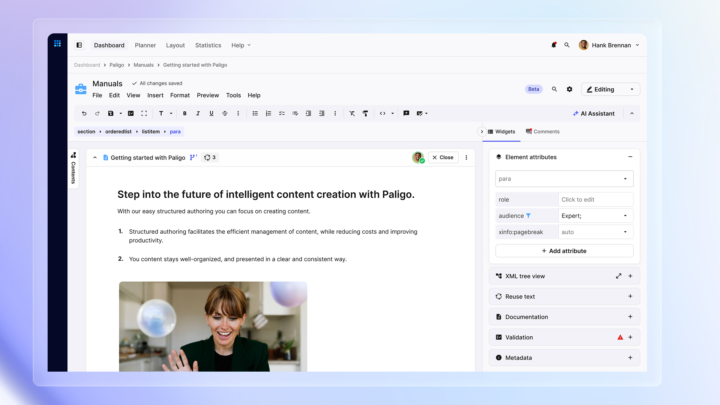
Authoring in Paligo enables you to create topics and edit the content in them. There's a lot involved in the system, so let's jump right in. You can easily create a new document or topic through the content manager. After you've given the new topic a name, you can open it in the editor. The built in editor in Paligo makes it simple to manage the content of the topic. You could make the text bold or italicized, along with adding images, tables, and other media. Paligo uses an industry standard XML schema or content model that enforces a structure, enabling you and your team to write quality and consistent content. If you want to see how the different XML elements are nested together in the topic, go to the XML tree view. This can be helpful for quickly moving elements into a new order. Insert elements from the toolbar or use the keyboard shortcuts to add them. To select an element or to take certain actions on elements, you can use the element structure menu at the top of the editor. Simply click the element in the menu, And from here, you can copy it, delete it, and so on. Adding images is simple too. After you've uploaded an image to the content manager, you could insert the image within the topics. You can also add inline images too. To save your content, click the save button. You can also turn on the auto save feature to make sure your content gets saved regularly. Every time you save your content, Paligo checks the structure to make sure it is correct. If there's a problem in the structure, the warning will tell you where the issue lies to help you fix it. You could also use Schemetron to help you validate your content against your own custom rules. After you have created your topics, you can place them in publications. Create a publication in the content manager. And then open its structure. From here, it's a matter of clicking and dragging your desired topics into the publication and arranging them in the order you want. You could use the arrows to nest topics within other topics, creating subtopics. When you're finished, save the publication structure. This structure determines both the table of contents and the order in which the topics will appear when you publish your content. Now that you've authored your topics and publications, you can translate them, invite collaborators to review them, and of course, publish them for your audience.