

Why unstructured breaks down as you grow
Teams don’t “choose” unstructured content as a strategy. They just start with what they know – a shared drive of documents, or a collection of Confluence spaces. At first, everything seems manageable because there are few products, few releases, and few contributors. Everyone “knows” where everything is, and copy-pasting feels faster than creating something reusable.
01
Duplication creeps in everywhere
Copy-paste content grows with every new product, variant, or customer requirement, leaving teams to maintain multiple conflicting versions.
02
Versions multiply faster than you can track them
Files and pages become separate “truths,” making it impossible to know which version is current across manuals, release notes, and help centers.
03
Updates take longer - and feel riskier
When a single change (like changing the logo) touches ten, twenty, or fifty documents, every update becomes complicated.
04
Reviewing and collaboration doesn’t scale
Comments come through docs, chats, and emails. Teams wait for the “latest file.” Review effort increases, but quality doesn’t.
05
It becomes unsustainable
Eventually, you spend more time maintaining what you have than delivering the new content you need.
Understanding why unstructured is not sustainable
Unstructured content creates more work as you scale – more products, more variations, more languages. Eventually, the challenge isn’t writer effort – it’s the content model itself. When your team hits this point, “good enough” is no longer enough. It’s the signal that you need to move from documents to structured, reusable content – with a single source of truth.


How are you creating your documentation today?
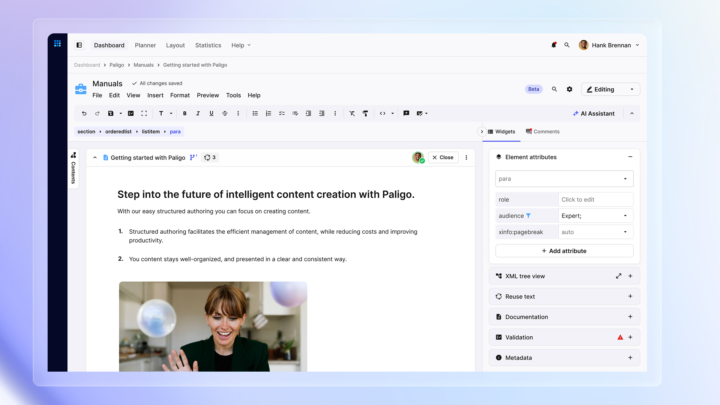
Compare your current method of creating and maintaining documentation to a structured content tool like Paligo.