
Back to Webinars
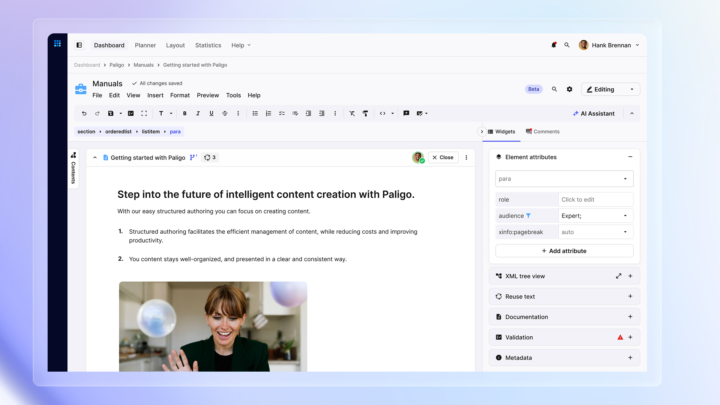
Welcome everyone to the product updates and 2022 recap webinar. My name is Jacob. I'm product manager at Paligo, and I'll be hosting this today. Today, we're gonna be talking about smart e-learning content. Some of our latest integrations, improvements we've made to the authoring experience in Paligo, some updates we've made to the Paligo API and more. Let's jump right in. Now, first, I'd like to mention something that we accomplished this year that we're really proud of, which is ISO 27001 certification. ISO 27001 is the leading international standard for information security. It ensures that organizations are equipped to protect their information. Now getting this certification shows our commitment to having the highest security when it comes to our customer's information. And we're going to continue to uphold the highest data security standards as a cloud-native SaaS company. Another exciting release from earlier in 2022 is our smart e-learning content. The brand-new e-learning output makes it easy to reuse all the content and documentation you already have and use it to create interactive training content with virtually any LMS on the market, straight from Paligo. The output interacts with LMS to track progress, quiz scores, and more. You can publish beautiful e-learning packages right out of the box, but you can also customize it to fit the desired look and feel of your branding. The e-learning output is available on the enterprise plan. And now to tell you more about some of our latest integrations, Fluid Topics, Netlify, and GitLab. GitLab adds to our collection of Git integrations. You can create content in Paligo and publish directly to any GitLab project or branch. Netlify is a platform that allows you to easily build, configure, and deploy websites. The new integration with Paligo brings with it one of the fastest ways ago from Paligo content to a hosted site with minimal effort. And finally, we've added Fluid Topics as a native publishing integration. Fluid Topics is a powerful content delivery platform. And with a native integration, you can easily deploy filterable, personalized, and searchable documentation. The Fluid Topics integration is available on the enterprise plan. Netlify and GitLab integrations are available on both business and enterprise plans. Continuously adding to our publishing ecosystem is hugely important as it makes your life easier, saving time and money and maintaining the integrity of your data across multiple business critical systems. It also enables personalized delivery, securely publishing the right content to the right target audience. This year, we made some improvements to the Salesforce integration which will have a big impact on users that publish to Salesforce. We've added support for publishing articles live instead of just as drafts. This means that you can now update content in a live experience cloud site without ever having to go into Salesforce, straight from Paligo. We've also improved cross reference resolution, as well as made it possible to publish both videos and SVGs to Salesforce. And that's not all. We also wanted to inform you about some upcoming updates to the Salesforce integration. We're going to be improving publishing personalized content. We're also gonna support publishing hierarchical content, so deep restructures. We're going to be giving you more granular control of the content you're publishing. And we'll also gonna allow you to preview the published results so you can see what will change in Salesforce before you publish. The Salesforce integration is available on the enterprise plan. And now for an overview of some improvements made to the authoring experience across Paligo. This year, we released the first version of our new contributor editor. Rebuilt completely from the ground up. This new editor will bring a new level of stability, more functionality, and increased control for contributors and authors in Paligo. It's free to use for everyone and can be activated from the system settings by any admin. And though it's still in beta, many have found it to be really pleasant to work in, and equally, if not more powerful, than the old editor. Besides making the contributing experience, more robust and user friendly. The technology behind the new editor will also open up for a lot more improvements and additional functionality going forward. We've continued to add various improvements to Paligo across the year, and we have more on the way. You can save your elements now in the editor for quick access in the element insert menu. You can now filter comments to make it easier to find a conversation that's relevant to you. You can also copy and delete elements from the XML Treeview. That makes it much easier to quickly make structural changes to your topics. Finally, I wanted to hint at an upcoming feature that's on its way shortly. Track changes or suggestions mode. Users will be able to suggest changes to content, but the content itself won't be changed until a full author accepts a suggestion. This will bridge the gap between reviewing and contributing, giving you as an author much more granular control in how you accept feedback and contributions on your content. It's been exciting to see how people are using the Paligo API since it was launched. It's been used for remote editing keeping Paligo content in sync with external data sources, managing translations, and automated publishing among other things. The API came out in 2021. And since then, we've been regularly adding new functionality. This year, we saw four new powerful features added. Next up, we'll be looking to support workflows and branching among other things. The API features this year will bring with them several new possible use cases. The variables feature makes it easier than ever to reuse micro content from sources outside of Paligo, allowing your content to more easily adapt a to change. The structure API makes it possible to automatically build entire document structures remotely. This means that you can create publications, structure them with your Paligo content and then publish - all remotely. The powerful search API makes it possible to perform advanced search queries on your Paligo content. If you're building structures, trying to find the documents to publish or preparing content to be translated, the search will allow you to find the content relevant to you. The Paligo API is available on the business and enterprise plans. And now for something that we're particularly proud of accomplishing in 2022. I'd like to take the opportunity to thank all the Paligo customers that have taken the time out to write so many kind and detailed product reviews on G2. It gives the team in Paligo a great boost to read about your experiences with the product. And it gives us some great ideas for the future. So thank you.