How AI is Creating Value in Technical Documentation


AI is coming for writers’ jobs. It’s a narrative of replacement and obsolescence that has many content professionals feeling anxious. In the world of complex technical documentation, the reality is far more nuanced, practical, and frankly, more interesting than the hype suggests.
To understand the impact AI is having on the technical documentation industry, we’re sharing how Paligo and Kapa.ai are working together – and individually – to leverage AI to create value in technical documentation.
Reading the Technical Writer Room
A couple of years ago, Paligo surveyed its customers to understand how they felt about AI. The response was split. While many were interested in seeing AI features in the Paligo CCMS, 60% had concerns, especially around accuracy and security. Things have changed a lot since that survey, and although technical writers are still somewhat concerned, many are more positive and excited about how AI can help them do their jobs more efficiently.
Paligo’s VP of Strategy and Business Development, Rasmus Pettersson, said that while certain parts of the content creation process could be replaced by AI, it’s unlikely to fully replace humans. What is more likely is that we will see a hybrid workflow in which technical writers embrace AI.
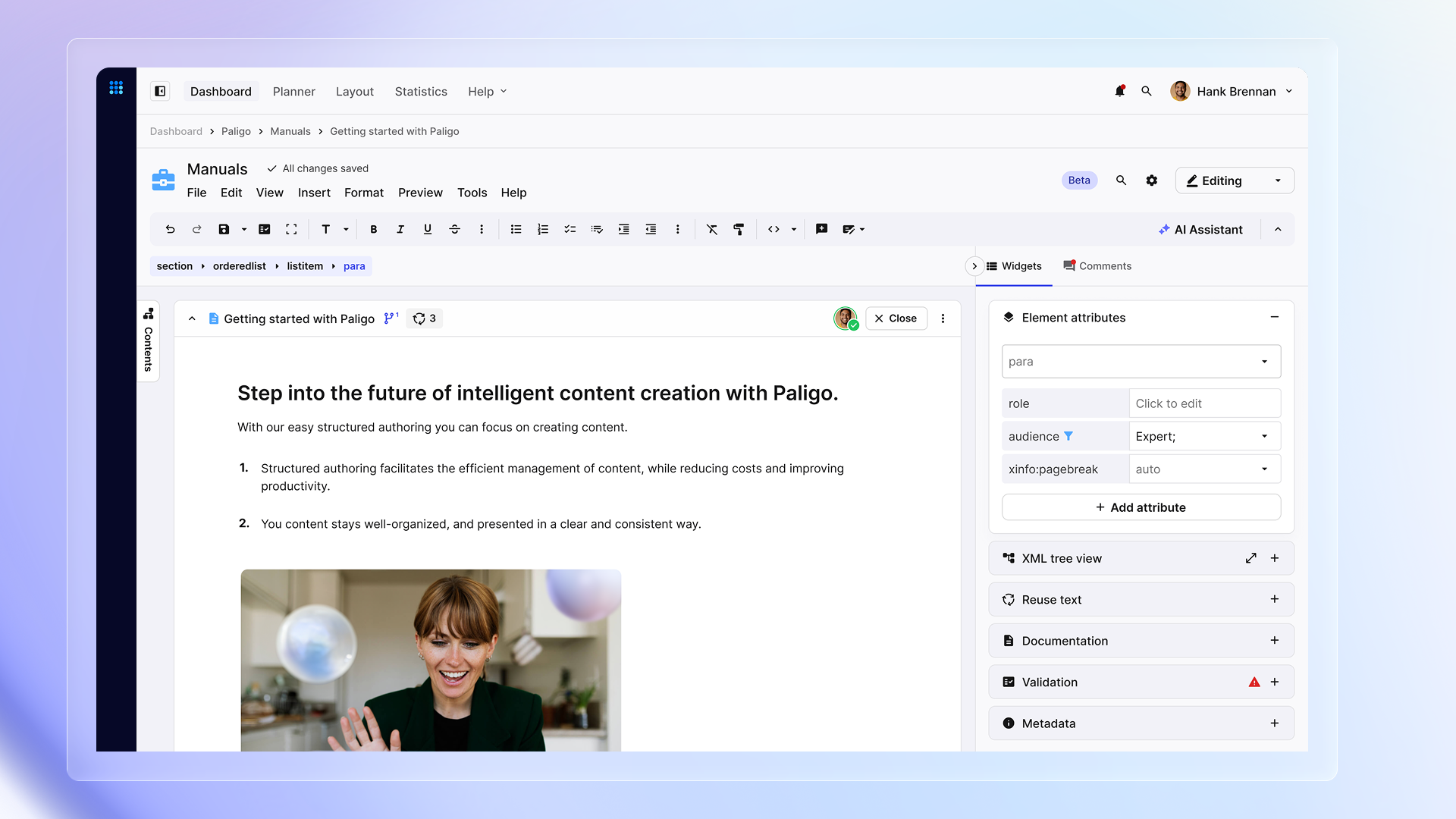
Generative AI is a huge opportunity for both technical writers and the companies that embrace its capabilities in the systems they use. That’s why Paligo is building generative AI into its component content management system (CCMS).
An AI Assistant Designed for Technical Documentation
One way software companies (including Paligo) are leveraging generative AI is through AI assistants that appear as a sidebar or a chatbot within an application. Around three years ago, Emil Sorensen (CEO) and Finn Bauer (CTO), co-founders of Kapa.ai, were looking at ideas to start a business, and this one hit close to home.
Sorensen said they had both been in situations or knew people who worked at highly technical companies and spent a lot of time answering questions that could have been answered if the employee or customer had simply read the documentation. Around the same time, ChatGPT launched, so they tried using it and similar large language models (LLMs) to create an AI assistant for tech docs.
It didn’t work. The assistant would make things up, wouldn’t cite the documentation, and there was no way to provide technical writers with information on how the content was performing.
To resolve these challenges, they developed an agentic RAG chatbot assistant (capable of reasoning through sub-questions like a human assistant), focused on answering technical questions from technical documentation.
Kapa ingests documentation sources, converts the information to markdown, and stores it in an index. It then uses an LLM (Kapa works with multiple providers) to generate the final output in a user-friendly manner.
Kapa answers come with documentation citations, so a user can always go directly to the source content. It can also break down a vague or complex request into specific sub-questions to improve the quality of answers.
The AI assistant is trained to respond with “I don’t know” when a user asks a question that the documentation doesn’t answer. Sorensen said those “I don’t knows” are interesting signals to improve your documentation. Which leads to analytics.
Sorensen said analytics has become the second biggest value proposition for Kapa. Customers can easily find gaps in their documentation using dashboards and reports. Kapa helps understand usage, uncovers patterns with common questions, and can help documentation teams prioritize content creation based on real user intent.
That same challenge—bridging knowledge gaps through trustworthy AI—made Kapa a natural partner for Paligo.
How Kapa Integrates with Paligo (or any technical documentation)
There are two parts to the integration between Paligo CCMS and Kapa.ai. On the front-end, there’s the AI assistant in Paligo’s online technical documentation. A simple script deploys the Kapa AI assistant within the documentation site, allowing customers to open a chatbot and quickly and easily ask questions on how to perform different functions in Paligo.
A great example of how Kapa can help Paligo customers is helping a customer understand how to publish documentation stored in Paligo to Zendesk. This is a multi-step process detailed across different sections of the Paligo CCMS documentation (integration, configuration, publishing). To understand the full process, a customer would normally have to go through each section and piece it together. Now, they can simply ask the Kapa AI. Kapa will go into the documentation, find everything the customer needs to know, and return a complete set of instructions with full citations.
Customers can provide feedback on the information the assistant returns, helping Paligo understand the effectiveness of the content and where it needs work.
On the backend, Paligo team members have access to the Kapa administration site, where they identify documentation for Kapa to ingest. One of Paligo’s most experienced Customer Success team members used Kapa during a customer call to find answers to a question he didn’t have, and he said Kapa returned very good answers.
Paligo’s Roadmap for AI
The implementation of the Kapa AI assistant for technical documentation is just one of the AI projects Paligo is working on. Pettersson describes AI as a “catalyst” that enhances existing capabilities rather than creating them from scratch. The idea is to help documentation teams who don’t always get the recognition (or budget) they deserve to do more with less.
Paligo VP of Product, Thommie Bohlin, said AI has opened doors that didn’t exist before, and there are so many things Paligo could build. He’s talking about features that could provide huge efficiency gains but also open the door to expanding ecosystem tools into the core platform (rather than keeping them as separate tools).
Right now, Paligo is focusing its AI efforts on solving difficult, time-consuming, but essential tasks. Bohlin provides several examples, including:
- A sidebar AI Assistant: Paligo is developing an AI Assistant to support technical writers during the content creation process. An AI assistant for technical documentation has unique requirements compared to the same assistant for marketing or sales content, so there’s a lot of work to ensure it supports technical writers in the best way.
- Improving content reuse: Content reuse is challenging for many tech doc teams, especially if they come from an unstructured content model background or are not trained technical writers. From a post-process perspective, AI can analyze content in the environment and identify overlaps, presenting them to the writer, who can then use the content in whole or in part. The overlaps might not be identical, but would have the same meaning and describe the same things. That’s step one. The next step is more proactive, where the AI analyzes text as it’s being written and suggests existing content with a similar intent, preventing duplication immediately and ensuring consistency.
- Streamlining translations: User trust in AI translation tools is growing, so integrating AI-powered translation directly into the authoring tool simplifies what can be a complex workflow. This option is a good alternative for less regulated industries who don’t need a human in the loop for their translations or the resources to add another tool to their tech doc stack.
- Simplifying content migration: Using AI to help import and structure legacy content is a key goal for Paligo, as it’s a major pain point for companies adopting a new system. This is not a simple capability to build, so it won’t happen overnight.
How does Paligo decide what’s strategic to build versus partner on? Bohlin said the benefits of building features are that they have full control over the direction of each feature and can focus on the specific requirements of Paligo’s ICP (ideal customer profile). However, there are areas where it makes sense to partner, such as the Kapa partnership for an AI assistant for product documentation.
Taken together, Paligo and Kapa’s work points to broader lessons about how AI creates value for technical documentation teams.
4 Key Insights on the Value of AI in Tech Docs
AI is proving to be a transformative partner for technical documentation teams. It doesn’t make good writing obsolete; it makes it more critical than ever. AI sharpens the focus on creating high-quality, deeply structured content and elevates the writer’s role from a simple producer to a strategic editor and information architect. The revolution isn’t about replacing humans, but about empowering them with better tools and invaluable data.
Here are four key insights that demonstrate the value AI brings to technical documentation.
The Most Valuable Answer an AI Can Give Is “I Don’t Know”
Kapa’s “I don’t know” responses are powerful signals for technical writers. Kapa’s platform clusters the most common questions that the AI fails to answer, revealing precise “coverage gaps” in the content. This provides a data-driven roadmap for documentation teams, enabling them to prioritize updates and new articles based on what users are actually searching for and what they are failing to find.
AI Doesn’t Eliminate the Need for Structure. It Magnifies It
Well-structured content provides the guardrails that AI needs to deliver accurate, reliable answers.
“It’s incredibly important to have it well structured. Because, despite all the headlines you see about LLMs getting better over time with larger context windows, the fact of the matter is, most LLMs are still very, very far from perfect, and they need a lot of help and guidance to understand quite complex products. And the best guidance you can give LLMs is lots of structure and hierarchy,” said Sorensen.
LLMs chunk up documentation to help with ingestion and understanding. Anything a company can do to chunk data before ingestion improves the accuracy and understanding of the LLM. Structured content is key to enabling Kapa.ai to provide the best answers.
Pettersson agreed, noting, “Content from structured authoring tools like Paligo, packed with metadata and a clear hierarchy, is incredibly readable for an AI and can supercharge its capabilities.”
AI Won’t Replace Technical Writers; It Will Give Them a New Role
Pettersson argues that AI will not replace the need for a “human in the loop.” Instead, it will accelerate a fundamental shift in the technical writer’s role.
He describes a “hybrid workflow” in which subject matter experts, such as engineers and product managers, create initial drafts. The technical writer then evolves into a “technical editor.” In this new role, their focus shifts to ensuring content is understandable, has the right tone of voice, and fits cohesively within the entire documentation set.
This change frees writers from time-consuming initial drafting and allows them to focus more on the outcomes of documentation. They can spend more time on what happens once the documentation is published.
This is where Kapa’s analytics can play a key role. Technical writers can understand how customers are using the documentation and if they are getting the answers they are looking for. Using this information, they can improve the content and fill in gaps more quickly.
Technical writers are interested in improving their productivity, but Product Managers, IT Managers, and marketers involved in selecting tools like Paligo CCMS want to know how Paligo can improve the customer experience.
By connecting their work to the ultimate goal of enabling the end user to use their product better, technical writers can directly impact core business metrics, such as Net Promoter Score (NPS). This elevates their strategic importance within the organization and proves the value of high-quality content.
According to Pettersson, this “new role” emerging for technical writers is not necessarily new; some of Paligo’s customers are already working in this way. AI, however, will drive change faster.
You’re Not Just Writing for Humans Anymore
One of the biggest shifts on the horizon is the need for writers to consider a new audience: AI. Bohlin explained that a major future track for documentation is creating information specifically for AI consumption.
He illustrated this with an example: a tumble dryer displaying an error code. When a consumer searches for that code, they should receive simple instructions, like cleaning a filter or calling a technician. But when a service technician searches for the same code, they should receive a completely different set of instructions, like a five-step guide to replacing a specific part.
Audience-specific delivery is only possible if the content is packed with rich metadata that identifies product lines, target audiences, and markets. The AI uses this metadata to interpret the user’s context and present the correct information to the right person. This elevates the importance of a structured, metadata-rich authoring approach even further. Can you do this today? Only with a lot of manual effort.
Paligo + Kapa Working Together
Kapa currently has over 200 customers, including OpenAI, Docker, Sentry, and now Paligo. Sorensen said the company is deeply focused on where the complexity of documentation lies. With the increased use of AI, it’s becoming easier to build products and software, but that also means products will get more complex, and people will rely on AI to help decode much of that complexity. This is where Kapa will focus its efforts, working with customers like Paligo to support their customer needs.
But they are also looking to make Kapa available to internal employees, such as solution engineers and customer success team members, who need to field product questions. In this use case, Kapa would ingest both internal and external sources to create a “super-powered’ AI assistant.
Kapa gets asked by customers they work with a lot about documentation platforms for various use cases. Sorensen said Paligo fits many strong documentation use cases, and they will recommend it where it makes sense. Paligo, for its part, will not only use Kapa on its documentation site but will also recommend Kapa to customers looking to implement their own AI assistants for documentation. It’s a partnership built on mutual respect for what the other is trying to achieve to improve technical documentation for better customer experiences.
FAQs: How AI Is Creating Value in Technical Documentation
How are Paligo and Kapa.ai using AI to improve technical documentation?
Paligo and Kapa.ai are combining structured content and retrieval-augmented AI to make documentation more accessible, accurate, and data-driven. Kapa’s AI assistant can answer technical questions directly from documentation, cite its sources, and help identify gaps in content, while Paligo integrates AI into its CCMS to streamline authoring, reuse, translation, and migration.
What makes Kapa’s AI assistant different from generic chatbots like ChatGPT?
Kapa uses a specialized retrieval-augmented generation (RAG) approach designed specifically for technical content. It only answers questions using the company’s own documentation, provides citations for every answer, and is trained to respond with “I don’t know” when it lacks the information—an important signal for improving documentation quality.
How is Paligo integrating AI into its own platform?
Paligo’s AI roadmap focuses on enhancing—not replacing—the work of technical writers. Current and upcoming features include an AI writing assistant built into the authoring environment, tools for identifying and reusing similar content, automated translation support, and AI-assisted content migration.
Does AI threaten the role of technical writers?
No. The article emphasizes that AI is transforming rather than replacing the writer’s role. Instead of producing first drafts, writers will act as technical editors and strategists, ensuring clarity, consistency, and usability. AI handles the repetitive tasks; humans handle judgment, structure, and voice.
Why is structured content essential for AI in documentation?
Structured content provides the hierarchy and metadata AI systems need to interpret and deliver accurate answers. Tools like Paligo make this possible by organizing documentation into reusable, well-labeled components that AI can easily understand—improving both automation and human readability.
Stay ahead in structured content
Get the Paligo Pulse once a month.

Share
Author