
How Beijer Electronics Modernized Documentation for Speed, Reuse, and Collaboration

For industrial technology companies, documentation is never static. Products evolve, configurations multiply, and accuracy is critical, not only for usability but also for safety, compliance, and customer trust.
At Beijer Electronics, managing documentation across hardware and software products had become increasingly complex. Multiple tools, large monolithic XML files, and manual updates made even small changes time-consuming and risky.
To scale documentation without sacrificing quality or control, Beijer Electronics set out to modernize its documentation workflow, starting with topic-based (structured) content and a component content management system (CCMS) built for collaboration, reuse, and multi-channel publishing.
From Fragmented Documentation to Scalable Content Operations
Beijer Electronics helps machine builders and system integrators worldwide drive efficiency and sustainability by turning data into valuable insights. It offers innovative solutions for visualizing, automating, and digitalizing industrial applications across marine, manufacturing, and rugged environments.
Beijer Electronics was founded in 1981 with headquarters in Malmo, southern Sweden. Over the last four decades, the company has expanded internationally and is represented in Europe, Asia, and the Americas. Beijer Electronics maintains a long-term local presence through proprietary local offices with own sales and support resources while carefully selecting value-added distributors (VAD) worldwide. Maintaining a long-term local presence is a crucial part of Beijer’s growth strategy and part of their customer-oriented approach.
Petter Bergeling joined the company in 2021 as a technical writer to support the current documentation workflow and to help the company investigate options to improve its documentation processes.
Beijer offers a number of hardware and software products that require extensive documentation (as well as multiple versions of products), including user guides, reference manuals, installation guides, release notes, and more. Multiple tools were used to create and manage this documentation, including Arbortext and Microsoft Word. Arbortext served as both their XML editor and a makeshift CMS, where they stored several large XML files containing all the product manuals. The XML files were packed with profile information of varying accuracy, making even minor updates challenging.
The company had several goals, but the most important was to improve the efficiency of the documentation process. Other important goals included improving usability for both internal teams and end users, increasing access to documentation through channels other than PDF and SharePoint, and ensuring uniform branding (including voice and visual brand) across all documentation.
Bergeling knew, based on his past experience, that the company needed a component content management system (CCMS) and set out to find the right one for its requirements.
Choosing a CCMS Built for Reuse, Scale, and Collaboration
Bergeling said they identified several key requirements for a CCMS. First, it had to be topic-based so they could implement a content reuse strategy. It had to support XML, modern versioning, and be able to publish in multiple outputs, including PDF and web. Finally, it had to support multiple users for both writing and reviewing content.
The search for a CCMS was narrowed down to three options: Paligo CCMS, MadCap AMS, and Document 360. Bergeling said he also looked at Confluence but determined it wasn’t a true technical writing platform.
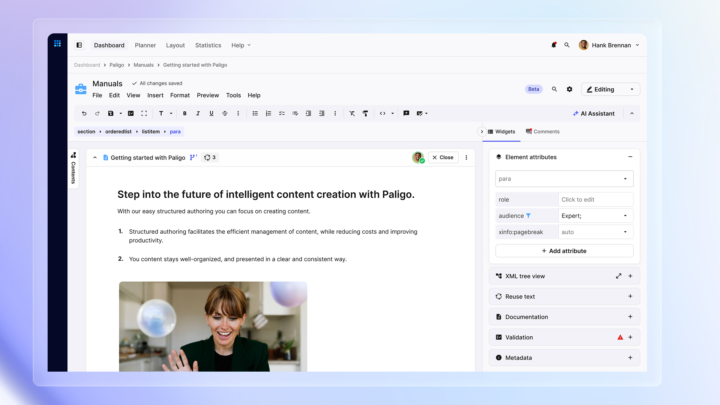
Paligo CCMS had most of the features they required and they really liked the intuitive user interface. After a demonstration of the CCMS, the decision was made to move forward.
Rebuilding the Documentation Workflow Around Structured Content
Not only was Beijer implementing a CCMS, but they were also implementing a new documentation process. He learned to use Paligo CCMS from online courses (and help from Paligo Support).
I felt quite comfortable with the UI and with Paligo from the start, so it was me learning Paligo from these online courses, and then I taught Urban [another technical writer] how to use it so that we both got some knowledge. I think it’s a great tool, and easy to use.
The first (and biggest) task Bergeling faced was migrating the old documentation into Paligo. The documentation was in Arbortext, and he determined that the easiest approach was to convert the PDFs to Word and import them into the CCMS, then manually fix the profiling issues. Once the documentation was imported, all new documentation was created directly in Paligo.
There is currently one full-time technical writer working on documentation, along with two contributors (product owners who write their own content) and 53 reviewers.
Collaboration has improved greatly. Prior to using Paligo CCMS, writers and reviewers worked with Arbortext, and email was the main way to communicate and collaborate on documentation. If someone wanted a change or found an issue in the content, they had to email the technical writer and wait. It was hard to make even the smallest change, and it sometimes took so long that people just stopped asking for changes.
Today, reviewers can post a comment on the documentation in Paligo, and the writers see it immediately, often making changes within hours and having those changes reflected in the Documentation Portal immediately. Because it has become much easier to request changes, people are much more engaged in ensuring the content is accurate and up to date.
As a tech writer and an information engineer, one of my main ideas is that if you have a company that has 10 plus products that they are maintaining and updating, then it’s hard for one tech writer to understand all the technical stuff about the products. Also, if you have one tech writer who’s supposed to know everything about every product, then there’s a huge risk when they leave. It will take years for someone new to learn everything about the products. So I think it’s really important that developers and engineers share their know-how in the documentation, and then tech writers polish it and make it more user-friendly. And Paligo has really helped with that. So that’s probably the thing I’m most proud of in this project, how we have gotten there.
There is also a support team that develops and maintains specialized documentation for customers with unique hardware and software configurations. These documents are produced in Microsoft Word, but they live on the new documentation portal, so Bergeling created a PDF template that mirrors the one in Paligo CCMS.
Bergeling said that Paligo’s support team has been very helpful with template customization and other questions and issues.
I’ve had a lot of discussions with the support team because we’ve asked for specific stuff that isn’t part of the standard template layouts. They’ve also always been super quick and really helpful. So the support team has been great for us.
In terms of integrations, the most important one is Single Sign-On to Beijer’s Azure environment using SAML. This allows writers, contributors, and reviewers to log into Paligo using their company login. Other integrations included Semantix for translations and Google Analytics in the Documentation Portal to understand how the documentation was performing.
In addition, Beijer is currently investigating Paligo’s new AI translation capability to support its multi-lingual requirements. The Documentation Portal is available only in English; however, the company translates some documentation into other languages, including German, French, Italian, Chinese (Simplified and Traditional), Portuguese, and Spanish, maintaining those translations in Paligo CCMS.
Measurable Results: Faster Updates, Higher Reuse, Stronger Engagement
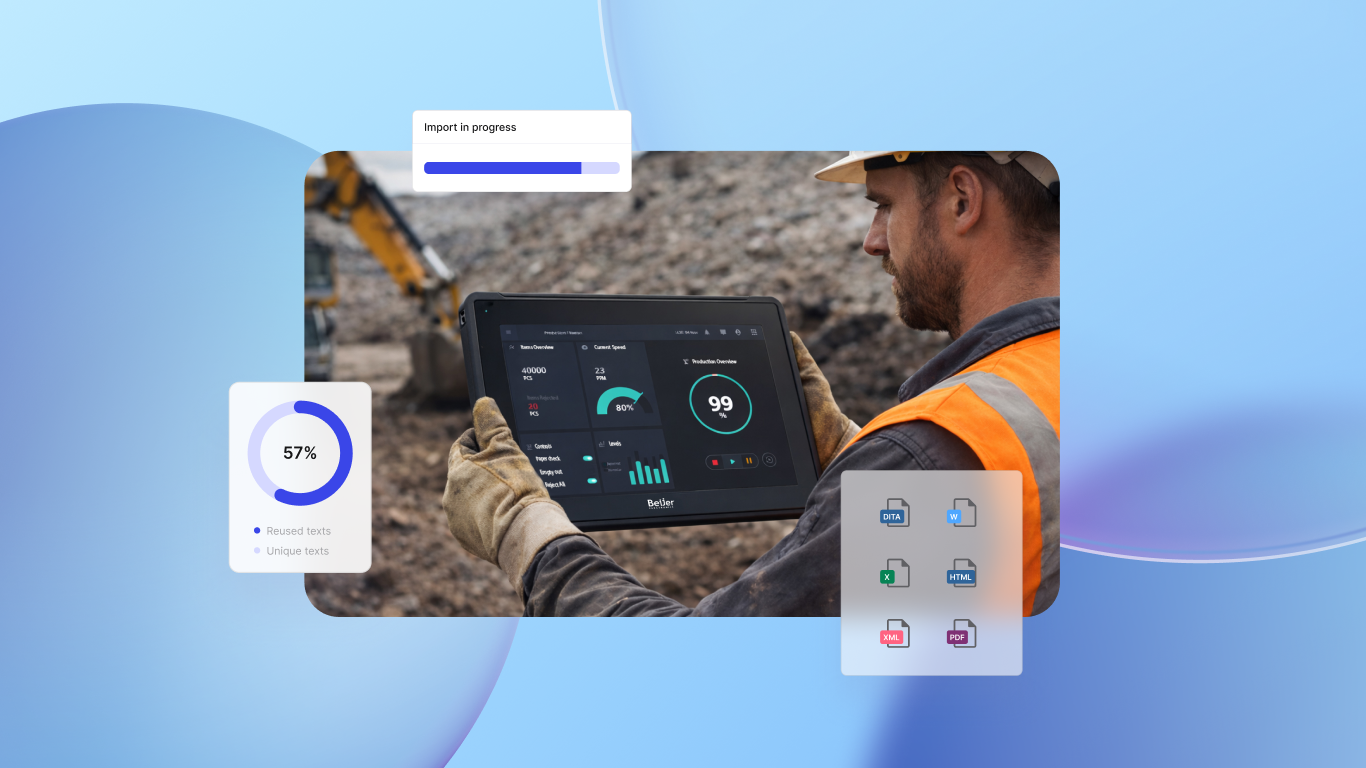
Overall, Beijer is happy with its new documentation process. It now provides documentation in both PDF and HTML5 (through the new Documentation Portal), and there is substantial reuse that can be easily tracked (73% of topics and 18% of images are reused).
Collaboration with the Support team has improved, resulting in less stress for them. Support can now send customers links to specific sections of the documentation instead of sending the full PDF or providing a download link and pointing to specific pages.
Documentation has become a real part of the company’s product again, with greater interest in ensuring it is useful for all users.
People are a lot more interested in actually having documentation that works. That goes for support, because it makes their job easier if they get like less people complaining or asking questions. Also, the product owners at the company are starting to take more pride in their product documentation, which was a goal from the start. But probably the biggest shift that I have noticed within the company is how many more people are interested in contributing and making sure we have good documentation that helps the customers, and Paligo has been a really big part of that.
Documentation as a Shared Asset
Today, Beijer Electronics delivers documentation through both PDF and HTML5, with content published directly to its Documentation Portal. Structured content and reuse are now measurable realities with 73% of topics and 18% of images reused across 463 publications.
More importantly, documentation is no longer owned by a single role. Engineers, product owners, and support teams actively contribute, while technical writers focus on quality, structure, and usability.
For Beijer Electronics, Paligo didn’t just replace legacy tools; it enabled a documentation process that scales with the business, supports collaboration across teams, and treats documentation as a core part of the product experience.
I highly recommend Paligo. It’s a great CCMS that makes tech writing fun. It’s easy to collaborate and get colleagues in other departments involved. There’s always a “next step” looming that keeps you interested in improving your documentation and how you present it to your customers.