Back to Webinars
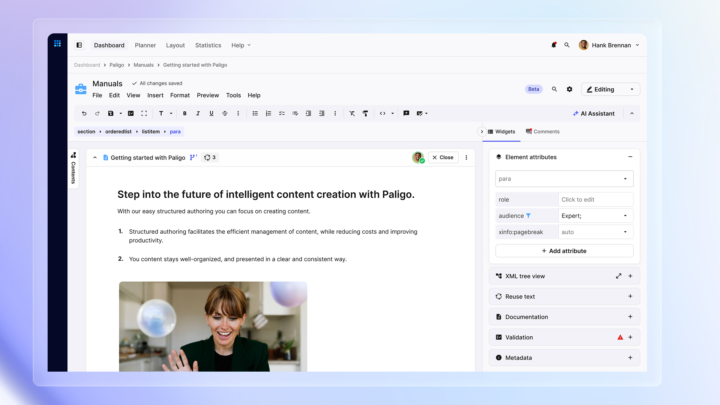
Wilcome on, Gianfuneau, welcome, and thanks for coming in. My name's Andrew Owen, and I'm solutions engineer at Paligo. Today, I'm going to talk about content management systems, component content management systems like Paligo and related solutions. This session is intended for anyone who's considering a seeing, a CMS, headless or otherwise, a CCMS or a content delivery platform, CDP. Should also be relevant to anyone who's considering migrating con tent from one solution, to another or with general interest in content delivery. My goal is that, by the end, you'll have an understanding of the difference between these solutions, an idea of the pros and cons of each and some insights into which might be a good match for your content needs. I'm not gonna assume any prior knowledge, so forgive me if I'm teaching you things you know already. And please bear with me for everybody else in the room who maybe doesn't have that knowledge. So what is content? It could be any kind of media, really, text, images, audio, video, and various formats, a word document, a JPEG image, an MP three sound file, an MP four video file. It's information that you want to deliver to an audience in a digestible format. And to do that, you want some kind of content management system. So the CMS is software that enables you to create edit, manage, and publish your content. The term is used as CATCH for a variety of content solutions, but historically, there were two common types of CMS. You're probably familiar with SharePoint. So that would be, an enterprise CMS. And then the other kind are the web content management systems. And of course, Now there are, you know, there's a web version of SharePoint. The majority of the content is now delivered in browsers. So the web form is the more common these days. Yeah. So for for context, we'll take a quick look at, the enterprise, content management. And typically, it's an on premises solution. So you buy the software, you install it on your own servers, You're on the hook for all the maintenance. You need the IT people to support it. That's why the web versions are becoming more popular. And it would include features like analytics, integrating with digital asset management systems, marketing, personalization, and scheduling. But as I say, these these legacy systems are are falling out of favor, even, that the larger providers are now offering, cloud solutions as an alternative. Right. So you've probably heard of WordPress. It's probably the most popular, web content management system, and it's used by around forty percent over the top ten million websites. Other popular CMSs are Drupal and Joomla. And one reason for the popularity of all these solutions is that they're open source software So you can actually get the software, install it on your own premises, on your own servers, and you've got complete control over that. The companies behind them also provide hosted solutions and other services. So you can have your content hosted by WordPress. You know, you can take this off run and run it on your own system, so there's that. And their features typically include collaboration, document management, graphical content editing, localization, presentation templates, and role based access control. So the disadvantages, would be the cost of maintenance, cost of scaling, latency, and security. And security in particular can be a huge headache for these systems. Because wordpress is the most popular CMS on the internet also the most targeted by malicious actors. So I think, one organization called World Fence reported in twenty twenty that there were more than, two and a half thousand attacks per second targeting WordPress sites. So if someone who used to work in security, that's definitely something I would take into consideration. With web CMS, content editing and delivery is done in the browser, and a headless CMS is just a slightly different approach. So with something like WordPress, you go to the site. It's all there. With a headless CMS, you you separate out the content and the delivery system. So then you're talking about, you know, you, you've got server based applications such as database delivering the content. You might have a headless editor, which will give you that graphical kind of interface, but you might actually be editing, content directly in a coding solution like visual studio code or something like that. And this means that all you need to deliver the content is a web server. And that could be if you're if you're familiar with, Apache or Microsoft IIS. Text content is typically written in mixture of markdown, which is a very simple markup language. Those of you who've been in tech writing longer might remember SGML, but, you know, sort of It gets rid of the tags, so it's really it's the simplified, system for writing, but it has the same kind of idea that the the content will have the presentation applied to it later, unlike say, if you're working in wood. And you may have grass glidesing ability, as I say. The advantage of headless CMS over a web CMS, is that it's scalable. It's low latency, and it's inherently secure because the content you're generating is static, so you don't have that, SQL database in the back end that's vulnerable. But to further complicate math there are now, a number of documentation solutions that, appear to be a web CMS on the surface, but under the hood, they're actually, headless CMS. And I, and I won't name them, but it's it's definitely if you're looking at, these kind of systems, it's it's worth taking a bit of a deep dive and seeing what you're actually buying. So if you need to get a website up and running quickly, a traditional web CMS is probably the fastest way to go about it. And it can still be a good choice for a number of use cases including corporate websites, e commerce solutions with dedicated platforms such as Shopify, and marketing websites. A headless CMS does take longer to set up, but it can be a better choice, than a traditional web CMS in many situations, and that's with things like cost of maintenance, cost of scaling, latency, multiple channels and security. So in other words, headless addresses the shortcomings of web CMS, but something to consider is the sheer number of combinations of solutions in existence and that can make it really difficult to make the right choice. My own personal website uses a headless CMS, and I set that up in in twenty twenty to, using a static site generator, and I use a head, headless CMS solution the gooey called Farris Street. And Farris Tree went away, and it's been replaced by a thing called Tina CMS. Now that's just my personal website. So I I was an early adopter. I knew the change was coming, and I only had my personal website to deal with. But there are businesses out there who had made this decision if you've heard of jamstack, this used to be that the standard platform would be netlify, forestry, and one of the static site generators And so out of the blue, all of these companies had to do this this transition, and they had about a twelve month window to do it. That's another thing that you have to consider if you're looking at headless CMS, are the tools gonna be that are you gonna have the support I think that's a really important consideration. So at this point, I hope I've given you a bit of a feel for what a CMS is. And maybe you've got an idea if it might be the sort of solution you're looking for. I'm gonna quickly pause the presentation out, to give you a chance to ask any questions if you're feeling a bit lost. Okay. So the question is, what do I mean by latency? So if you think about it, you have, on a website, you've got one server maybe. If your number of users hitting that server is in the tens or even the hundreds, you're not going to experience any latency. You'll be able to serve those requests But if you have maybe a thousand users hitting the site and you're running that off your own server, you can find that those user requests. Some of them will be dropped just because of the inability to service their requests. When you go to something like a hosted web CMS, then you will have, content distribution. So it'll be redundant service so that whenever those requests come in, they'll be able to be served. So that's just something to consider. It's if you if you have a very small number of users, latency probably isn't going to be a problem for you. Anymore or shall we continue? Okay. Great. So in talking about CMS, you'll note that I haven't mentioned user document something that they're suited to, and with good reason. A CMS is a general purpose tool, but a CCMS is designed specifically for documentation. But I'll let you into a secret. I'm not a huge fan of the term CCMS because I think it's confusing. But I'm not in marketing, so I don't have a better term for it. What makes the CCMS different? So, authoring? When you have more than one technical writer working on a project, CCMS is usually a better solution than merging changes using a software repository. Structure. Open XML standards like docbook and Ditter impose a structure on the content creation process, and that provides consistency for your audience. Reuse. The CNC CMS stands for components and these elements can be as small as a single word or as large as an entire publication. By reusing that content, you reduce the amount of documentation you have to manage while increasing the amount of content you can produce with the same number of writers. Versioning. So, yes, in the CMS solution where you're using a code repository, you do get some version control. But CCMS offer a much more nuanced, set of versioning. So you will have individual changes over the, any of the, the components of the document. But the publications themselves will also have version management in there. So if you, you know, need to go back to, a manual that you produced ten years ago, because it you have regulatory compliance. That's, again, really good use case for CCMS. Collaboration, so integrated workflows You're probably familiar with, you know, you create a PDF for something and you email it to somebody and you're waiting for something to come back. Most CCMS will take all of that into the CCMS system. So reviewers, collaborators, SMEs, they'll be users on that system, and you will create tasks for them, and you'll manage them in the system and all of the work is done in the system so that you have complete control over your workflow, which aside from the efficiencies, it it just makes it much easier to manage your work. Translation, reducing effort required in what is often the most expensive and time consuming part of the documentation creation process. All of the, the content that you need to translate is managed in the system, and you only translate what actually needs to be translated You'll have integrations with translation agencies and services, and that means that you're only paying to translate the new content or the content that has changed. And you've got complete transparency over again. It's the same with the planning with with the writing and the editing assignments, so you can keep track of that. Presentation. So I've got a whole other talk about the difference between document creation solutions like wood and what I would call document management systems, CCMS. It's that separation of style and content. So in word, you got all your local styles and how you do consistency. In a CCMS, you separate that. So you have the content in this XML format. And you apply the style when you publish. So it can be styled completely differently for different channels. If you're going to, HTML help online or PDF, or maybe you've got, you know, co branding or or white labeling and you need to have different outputs for different regions. You've got the single source of content. You make no changes to that. You just apply the layout that you need when you publish. Alright. Okay. I know that. We're still on the right slide. Don't don't worry. We'll get to the next one, but thank you. Integration. So, it's easily configurable to integrate with other services, and these can be things like ticket deflection, with Freshdesk, Zendesk, that kind of thing. Messaging, Slack, and Teams, so the system will send notifications to channels. Advanced search. So, you know, as a CCMS provider, Paligo search isn't what we do. We do CCMS. So we will let you integrate with services like Algolia and Coveo, and other CCMS providers will will have the same kind of offerings. Get repositories as much as you don't want to do your version management in a git repository. It can be quite useful to publish to one so that your output had got that, track changes on it. Webb hosts. So some CCMSs will offer hosting as well. We don't at Polygo because we think that there's too many different use cases out there and we can't serve them all well with a single solution. Again, so when you're shopping around have a look and see what works for you. But, for other CCMS like us, where we don't do the hosting, we will integrate with hosting providers, and that can be things like, Amazon S3 buckets or Netlify. And then as I mentioned, translation before, so translation services there can be direct integration so that you essentially, you know, you trigger a translation to happen, and the CCMS will send it to the translation service translate it, it comes back. You don't have to do any of the file management. And then lastly, content delivery platforms, and these are things like fluid topics and zoom in, these are platforms that will integrate a lot of content from a lot of places and enable you to serve it to your audience in one place. And I'll go into more detail about that later. So, right. That is the right slide. So If we have a look here, I think it's fairly clear with different song on-site between the CMS and the CCMS. So CMS is really a general website tool. And a CCMS is is particularly about documentation. And that, you know, that could be pretty documentation online or built into, you know, if you have machines that have got this way of preserving HTML. The content on a CMS is all deleted. You can throw out all of your content in the But on CCMS, you're really it's it's text and images. Normally, for things like video, those will be with the video, platform, so please, Lavinia, I'm just in Beverly. Automation, CMS, you should have built in workflow. CCMS will be using rest APIs to achieve that. So if you want to do automation with CCMS, you need a, a set of developers that can talk progress to APIs, and be able to do it that way. With third party integrations on CMS, we're talking about components, it's usually things like plugins for WordPress on the CCMS cybertoprass services, so again, like those search providers I mentioned. Structure, again, unstructured versus structured. So, external standards like dog book and data mean the can only put certain content in certain places. Like, for example, you can't put an image above a heading. With unstructured, you can put any content anywhere you want. So when the name is to clearly communicate to an audience for the purposes of documentation. I will always go to CCMS over the series. Presentation, as I say, with things like WordPress and and other CMS just like that, presentation is all combined. And with CMS, you separate that so that you have different layouts for different targets. And then finally, the posting. So CMS posting is all integrated. So Cimeters in the pet on the provider. So I mentioned this before. When when I talk about tools, I talk about the, the document creation tools and, the kind of presentation tool. So on the one side, you've got things like words and indesign, and that's, kind of that's probably what you're gonna be using if you're using a CMS and a quark is here as well, but, you know, they have a CCMS offering now. So I'm very interested to find out about that. And then the other category is what I call the document management tools, and that's what we're talking about here, the CCMS. So think the crucial difference is how the content is used, and I think I've I've kind of covered that actually. So I would say if design is your highest priority, That's when you wanna go for the document tools. If you want the absolute fine grain control of where you place, an image on a page, particularly for print perhaps for things like, sort of printed warnings for, you know, dangerous environments and that kind of thing. And you, you know, clarity and all the rest of it is your absolute priority. But I think where you the focus is the actual content and you wanna map the content to the layout instead of the other way around, that's where you want the document management tool. So when should you adopt a CCMS? I think, in my experience, and I I was a technical writer for nearly fifteen years, and I've worked on a lot of different systems. I've worked, in in all of different industries. You can read the blurb later. But in my view, a CCMS is really the only solution you've got two or more writers that are working on the same content. When the volume of content has become too large to manage in a file system, CCMS will have a database in the back end, and you're not dealing with files. So if if if documents and topics move around, they're connected by their identity in the database. It's, you know, you don't get broken links within the system. Another one is when the content has to be translated in two or more languages. My personal website, it's CMS. I translate into French. It's manageable, but if I had to do German as well. At that point, that becomes very, very unwieldy. So, again, it's I think that's a definite reason you would go for CMS. And then finally, when the number of concurrently maintained versions of a document exceeds one. So if you've got, you know, customer funded development, or if you if you have to maintain all the versions in manufacturing, for example, you absolutely need a CCMS at that point. So, actually, I think I've kind of covered what I've got on this site slide, which is about hosting. So, now it's time for frequently question where you can ask me anything. I'll give you an answer, and then you can question it later. Yeah. So the question is, is co creation supported where SMEs and all can work together. So yeah, collaboration is a really important part of the CCMS. And what that usually means is that there will be separate accounts for all of those collaborators, and the view that they get won't be the same view that the author gets. So the author will kind of get the the everything view. The collaborator will usually go to simplified editor, and typically they're only allowed to work on the assignments that they're given. So you might assign them an entire publication. If it's a reviewing, type of assignment, or if you actually just want them to create some content, you might just assign them a topic, and then that's all they can see, and you give and then that's in your plan, and you can see, you know, Alright. See how long they've got to do it. You know, whether it's due and again, you know, they might get a notification through Slack or teams or or one of the other ones So but it's all included in the system, and that's the idea because you don't want this kind of email chain going along, but you can't really easily manage. Okay. So the question was, are we planning to integrate with large language models? So, yeah, you'll notice, at the conference. All all the talk is about AI and chat GPT at the moment. So Yep. We're investigating it. We've got teams working on it right now, but I would echo, the keynote. There are some things that LLMs are really good for. But there are a lot of caveats with it. So as writers, I think one of the first ones, to be aware of is that in the US, at least, machine created content is not protected by copyright. If it's not created by a human, there is absolutely no protection at all. And then the other thing is that, just how we're doing on time. So I've been following AI for a very long time, right back into the nineteen nineties. And the I think there's there's a huge amount of talk about what it can and can't do, but I think it's important to understand what an LMM actually does And the kind of the minutiae of it is you give it this, set of instructions and that is interpreted by a natural language processor. And we're getting quite good at that in in AI now. But what it outputs is one word at a time, what's the next most likely word to come after that word, and it has a, a word memory of about two thousand or so characters. So once it's got, it's kind of like a a I'm trying to circular buffer. Sorry. Been a while since I did my, master's degree. What, once that's full, it moves along. And whatever it's already generated here, it doesn't know about it anymore. And it just keeps going. And all it's doing is predicting the next word based on the information you gave it and based on the dataset that you gave it. And it can sound very convincing and very compelling, and it can also be complete nonsense, and you won't know. So Where I think it has, some use and this is just my personal opinion. This is I'm not speaking on behalf of of Poliga with this. I think the the first use case I found for it that I think is really compelling and nobody seems to be doing this. So, you know, please take this and run with it. If you're in instructional design, and you have to make multiple choice, quizzes. Once you've got the right answer, give that to chat GPT and say, give me four compelling sounding answers that are wrong based on this. And I think because that's I could never do that when I was being to do instructional design. It's very hard to to think of a question that, answer that sounds legit, but isn't, you can use it for that right now. It's really good at it. Yeah. That's that's the one I think it's it's ready for for production right now. Other than that, I think probably what you're gonna see is, I'd actually going back to my own site. I use, for social media management at tool called buffer. And, the idea is that you create your content there and it publishes out to multiple social platforms. They've got an AI integration that when you're writing that content, it makes suggestions. And that I think is that's good because you then you're looking at it and and it's saying, well, you might wanna consider this And then having done that, it's like, oh, yeah, that that's really helpful. And I think that is somewhere. So you as the writer are still creating the content. That solves the copyright problem. Also, you as the writer know whether the AI is talking nonsense or not. So again, I think it it addresses that. We we because of understanding the difference between CMS and CC CMS, we'll see CCimeters, although you can't even characterise them as if they're they're all the same if you like. Yeah. But there are there are huge gulfs of differences between you know, desktop. C c s dot com of a, yeah, onto the Paligo Yeah. Scale. Yeah. In the scale, and the vesence and the the huge, you know, basically those huge linking options in the core Yeah. On a scale c c message. So how do you characterize the difference between one and the other. What's going on different? Because why wouldn't someone spend a lot of money using this rather than me? Okay. So I think If you look at historically, we've very much moved from everything is on premise to where possible everything is in the cloud. There are still use cases where the cloud is not viable. Typically, you're talking government, military, anywhere where you need that data locked down. Now in the US, there are Amazon, web service that are rated. They're they're fully, compliant with all of the government restrictions. So export licensing can be another example. But to maintain that, you need an entirely US based workforce who work on that because no non US citizen is allowed anywhere near that. And in those instances, for companies who are basically providing a document solution, unless they're part of a much larger organization that can the overheads to do that, that's not a market that's worth being in for them. So if you look at who is in that space and able to provide that, that would generally be part of of I mean, I'm not sure if IBM does it, but it's that kind of scale. So that's one reason why you would, you would still go on premise even if you have that large amount. And then there's you'll hear probably quite a lot of, of talk if you, if you dig into this on the differences between doc book and and Ditter, which are two, you know, they're just two open XML approaches. They're they're pretty comparable at this point, really. But Ditter is a bit more restrictive. And if you are a company of seventy thousand people with, globally distributed teams of writers numbering in the hundreds, you probably want a lot more restriction on the content that they can create so that you can actually you know, create consistent content globally. And in instances like that, that's where some of these, you know, digit database solutions that that really kind of funnel the writer down a particular route are worth considering. Do do you need to have a team that big in order to get the benefits from that of control, you could argue that that if you've got a team of five people trying to get five technical writers, writing in the same way, it's virtually possible anyway. Well, I mean, so so the way that CCMS, would normally handle that you, you would have integrations for, right, like style tools. So things like try and remember the name of them, but acralinks, is one writer is another. And this can impose a style. And then because it's XML, there's also a thing called schematron, so you can actually create rules around what you can and can't put into the XML. So it it is possible, to do it, but I think it's sort of if you wanna do it at scale, sometimes deter just makes that easier. Where where does Caligo suit? Because we we have quite a bit of time. Sure. So it's about Caligo as a CCMS. Okay? Love to. I mean, so I'm, you know, the as it well yeah. So I mean, as I said, there there are other CCMS out there, but I personally was Polygo use it before I joined the company. And Paligo's kind of reason to exist the the founders I think it was back in twenty fourteen. There used to be Ditter consultants, and Ditter takes a long time to set up Now you've got kind of packaged solutions now, so it's not so much of an issue. But, back then, really it was kind of like, here's all this open source stuff. Go build yourself a system. And you would get, you know, sort of like a skeleton, but you had you had to put the flesh on it. And that would mean that the lead time to set up a system would be a minimum of six months probably anything up to two years. And they're like, but there's got to be a better way. So docbook is an earlier standard. It was created O'Reilly, the, computer publishing house, and it was designed to meet all of their needs. It's now managed bioasis, which is the same steering committee that manages data. And it's very much, designed to kind of give you everything you need out of the box It's it's tailored towards software documentation, but it's flexible enough that it can be applied to other things like, you know, sort of pharmaceuticals, manufacturing, and and other kinds of things. So, the founders of Polygo looked at this and went, This is the way to go. So they built a system based around that. The other thing is that all of I mean, because Docuq's been around for longer, it's sort of more well understood, but one of the the hassles at the time, and I once built a Docbook system myself before Paligo existed. Actually getting getting that output into a really nice PDF was kind of unpleasant because you had to work with, style sheets and you needed to know XML and you, you know, it was it was clunky. So one of the first things they did, they addressed that. So in in Paligo, you don't write any code to do your layouts. You have a layout editor. And if you're if you're publishing to HTML, then you can bring in your CSS and your JavaScript if you want to, but you don't have to. And and again, there's a, there's a huge focus on producing really nice pdfs as well. So, you know, we're not in design. You don't get quite as much flexibility on where you you place images, but you can flow text around images. You can you can any any kind of user manual you want to create. It's it's well within our ability to support that. And then it's just the user experience. So in a lot of the data systems, I've I've used, you have to learn data. You need to know. What's the next tag? Maybe you're writing in an XML editor that's designed for a developer and not for a writer. So, you know, You're right. You're not a developer or maybe our developer, but even as a developer, you're using things like oxygen and x metal. It's not the nicest experience. In Paligo, we hide all of that behind the scenes. It's there if you want to. You can hit the code editor and you can see all of the XML, but normally you're typing away, and it's really no different than using Google Docs or, Microsoft three sixty five, you're just typing, and you hit return, you get a new paragraph, and so on and so forth. You've got, a really simple, kind of toolbar across the top. Everything's pretty straightforward. And it's it's simple enough that, you know, there there isn't a huge learning curve to get on with it. And when you want to insert an element, you just hit alt and enter and you know, it'll give you a list of of all of the available elements, but it prioritizes the ones you use most often. And so we try and we the other thing is when we when we educate, so we know that documentation teams grow. So when, somebody comes on board, we do the training. We the idea is, you know, train the trainer. So if if you've got one writer that's come on board with us, you bring on another writer, your first writer will be able to get them up to speed very quickly. And then it's just, yeah, making the whole workflow, really straightforward and easy to use. I can tell you a little bit about the technology. So, Yeah. We're here. So, I mean, please do come and see me at at the at the booth, and I'm very happy to show you the software and let you have a play around on on my instance. And, any further questions, I'm I'm very happy to, to do that for you. But, that's, so that's a little bit of a flavor of Polycoma. I don't know if Yeah. So the question is does it output to HTML five help? Yeah. So all all CCMS is including ours. Will have some kind of separation between content and output, in our case it's docbook. So you've got the XML and then essentially that there's a tramp. Sorry. Okay? There's a transform that goes on, to turn the source content into the output content. So we have, an HTML five online help output. There are various different themes, that you you get as part of the product, but you can modify all of those. So you can change your color scheme, your typography. You know, we, we put effort in as well to make sure that these are accessible and that they scale. So It's one site. It looks the same, to the user, regardless of what they're looking at it on, it will scale to a mobile phone size, and it it's compliant. We would it's kind of accessibility is something that we have to keep working on, but we have good accessibility now, and we're we're making it better. So I mean, we, we do other outputs as well. So there's PDF HTML, scorm. It was something I haven't mentioned. So we integrate with learning management systems. So you can publish, depending on, like, we have different tiers, but, at one level, you can actually create quizzes in LEgo and push that out to a learning management system. So we're not an LMS authoring tool, but it does give you that ability to reuse your content. Yeah. Okay. So it's really important to be, compliant with the regulations where you work. The way we handle that is we have, three servers. We have one located, in Japan. We have one located in Dublin, which serves all of Europe, and then we have another one located in the US. So if you're in the US, we are compliant with the highest level of US regulations on on data privacy, and that's pretty much California. In Europe, we're compliant with GDPR. And and all of that. And in Japan, it's the same. So you own your data. That's another difference. So I think between us and some of the systems out there. So It's your data. You can pull it out as easily as you can put it in, and it's in an open XML standard. So you can take that and you can move that wherever you want. There are, I think, at least one of our rivals got advertised as they they can import our content. It's really trivial to do it because we're not locking you in. We think our experience is compelling enough that if you you find that we're a good fit for you once you're on board with us, we don't think you're going to want to move. So we have no interest in locking you in. And then on the other side of it, you know, we are ISO certified to the, the the security standards for Europe. And Amazon itself has of a certification so that we make sure that the data is secured during during transit and We have role based access as well if you need to limit who can access access the data in the source files. Just curious about the use case you took a documentation. They were from a legal perspective, is there any particular industry, I mean, particular use case to see come up quite a lot defining your efficiency rest. I well, as I said, it's kind of the those four cases. It's when you're you're doing multiple translations or when you've got multiple writers working on the same content or if you've just got so many documents that you need a management system to manage them. In terms of industry, I mean, we have got customers from from across the board in in manufacturing pharmaceuticals. We, I mean, there's a heavy emphasis on software because you know, software companies are kind of aware of what's happening in the documentation software space, but we really see ourselves as, as being a general us, CCMS that's applicable to any industry. And, as I say, we're we're here, for the whole conference. So if if if I picked your curiosity, do stop by and visit, and I'd be happy to tell you more. I was going to talk a little bit about CDPs, and I kind of skipped over it. So I'll just mention it again. If you're looking at hosting and you wanna bring in things like knowledge bases, another content content, delivery platforms like fluid topics and zoom in are definitely worth taking a look at. They can actually be really cost effective because you're, instead of paying for you in a separate hosting and other services, they can bring all of that together, and they, and they offer integrations you won't necessarily get on the standard web host so they can actually have this AI backed, chat integrations and that kind of thing. One of the things, that I think often gets overlooked, in technical communications is discoverability. And that really it's kind of, you know, what good are the docs to your users if they can't find them? So I always kind of encourage people make make your doc publicly available, but more than that, make sure that you have good search integration, and these content delivery platforms can be a really effective way to, to do that. So if you're finding that your users can't find their content, it's definitely worth having a look at them. And at Paligo, we integrate with a couple of them and I'm sure our competitors have integrations as well. The question was can you integrate Paligo with FluidTopics? Yes. We have a direct integration for that. Okay. I think that's everything. And thank you very much for coming.