Content Delivery Platforms and Paligo CCMS: Powering Multi-Channel Documentation


Delivering consistent and accurate technical documentation across every customer touchpoint is no longer a luxury—it’s a necessity. Customers want access to technical documentation through digital channels: knowledge bases, customer support portals, mobile applications, help centers, and chatbots.
It’s no longer about the traditional PDF support guide.
Creating and managing content across multiple digital channels is challenging for several reasons, which is why many companies are turning to content delivery platforms (CDPs) for help. But setting up multi-channel delivery requires more than implementing a CDP—and that’s where a component content management system (CCMS) comes in.
In this article, we’ll examine the need for a content delivery platform and how, when integrated with Paligo CCMS, it can efficiently deliver consistent, up-to-date technical documentation in your customers’ preferred channels.
Key Takeaways
Single-source authoring eliminates inconsistencies — create once, publish everywhere with confidence.
CDPs handle multi-channel delivery — automated publishing to knowledge bases, mobile apps, and AI systems.
Translation costs drop significantly — structured content means you translate each topic once, reuse everywhere.
AI readiness requires structured content — XML-based authoring optimizes AI training and retrieval accuracy.
Combined systems streamline workflows — eliminate manual publishing processes and tool proliferation.
The Complexity of Multi-Channel Content Delivery
Before we talk about content delivery platforms in detail, let’s dig into the challenges of multi-channel content delivery. Four reasons stand out.
Providing Consistent Content Across Channels
This challenge is customer-facing and highly critical from a customer satisfaction standpoint. It’s one thing to have multiple channels providing your customers with technical content and product information, but customers get frustrated quickly if that content isn’t the same across those channels.
Inconsistent information also leads to increased support inquiries—the exact opposite of what you’re trying to achieve by making the information available to customers. Technical content can quickly get out of sync if you manage separate channels using separate tools and processes.
Keeping Content Up to Date Across Channels
If you’re publishing technical content to more than one channel, you need to consider the requirements of each channel in your publishing process. You might publish HTML5 to a knowledge base or website, CHM files for in-application help, and PDFs for a customer success portal.
Some channels have different update requirements, too. In-app help may not need to be as up-to-date as a continually used knowledge base. Then there’s keeping track of what version of your documentation is published where and ensuring updates are published in sync. The logistical challenges to managing multiple channels cannot be understated.
Managing Technical Limitations
Let’s talk about the unique formatting requirements for each channel a little more. It’s not uncommon to create and manage technical content using different tools to support different channels.
PDF content is created and managed in Word or Google Docs. In-app help content is managed using help-authoring tools like RoboHelp. Help center articles are managed using the authoring tools of the help center solution. It’s the same technical content, managed three different ways, using three different tools.
Keeping those environments in sync whenever there’s an update to the content—large or small—is a time-consuming and error-prone manual process.
Supporting Multilingual Experiences
Depending on your business requirements, you may need to translate your technical content into more than one language. Imagine doing that when you have multiple channels that manage content in different tools.
Now add the need to localize that content to support regional differences, such as the product name or available features. Providing documentation in multiple languages requires careful coordination to maintain consistency. Managing updates across translations without introducing errors or delays adds complexity that traditional multi-tool approaches struggle to handle.
Preparing for an AI-Infused Present and Future
Understanding the challenges of multi-channel technical content delivery is essential because you need to address them upfront. But there’s another aspect to multi-channel content that we’re just now trying to understand and design for: AI.
Large Language Models (LLMs) ingest information to support generative AI interfaces—conversational AI support experiences like chat or co-pilots. If your technical content is managed in siloed content management systems and different formats, providing a unified content source for AI is difficult.
Consider the website chat that’s only trained on your website content. What if a customer asks for detailed troubleshooting steps that aren’t available on your website? If the AI doesn’t have access to all relevant content sources, it may provide incomplete or fragmented answers. If each AI tool has ingested information from different sources, it may also provide different or contradictory responses—confusing customers who use the tools for different situations.
AI models perform best with structured, well-organized content to deliver accurate, contextually relevant responses. If you create technical content in different formats for different channels and then feed all this content into an LLM, it takes more work for the LLM to understand it all correctly. This can lead to incomplete, outdated, or conflicting responses.
Content Delivery Platforms: Streamlining Content Distribution

We’ve discussed many challenges related to creating, managing, and publishing content to multiple channels. Now let’s examine one part of the solution: a content delivery platform (CDP).
A content delivery platform is a SaaS solution that curates technical and product documentation from any source or format, unifies it, and delivers it to multiple channels—documentation portals, knowledge bases, websites, in-product help, and AI/LLM tools.
CDPs don’t provide authoring tools. They connect to other sources with authoring capabilities, such as component content management systems. CDPs focus on unifying content from these disparate sources and delivering it to one or more channels.
In some cases, a CDP will provide a delivery channel; in others, it’s simply a conduit through which you can deliver the same content to multiple channels. FluidTopics, Zoomin from Salesforce, and hosting services like Netlify are three examples of content delivery options, each offering unique capabilities to publish technical content.
Common CDP Features
Every CDP works a bit differently, but there are common features to look for:
Content ingestion from source systems and formats through out-of-the-box connectors or custom integrations using the CDP API. The ingested content is transformed and normalized to create a consistent schema that’s tagged and indexed.
Search capability, often powered by generative AI, helping documentation teams find the content they need to publish.
Channel connectors, including out-of-the-box integrations with platforms like Salesforce Knowledge, plus REST APIs for publishing content to websites, web applications, mobile apps, and other channels.
Personalization using information about the user and generative AI capabilities to tailor content experiences.
Usage analytics and SSO for understanding how content performs and managing secure access.
Depending on the CDP, built-in publishing solutions like documentation portals and field service mobile applications may also be available.
The Power of a Combined Approach: CCMS and CDP
Using a CDP to deliver technical documentation to all your customer channels is just the beginning. Authoring content to send to the CDP is the second and equally important part. That’s where a CCMS comes into play.
One of the capabilities of a CDP is the ability to ingest content in any format and transform and standardize it. However, it doesn’t analyze content sources that contain the same information to identify the most up-to-date version.
It also doesn’t know if the information is accurate or which source contains the accurate version. The content is assumed to be accurate, consistent, and up to date—and when it isn’t, it’s the job of the source system to push new versions to the CDP.
If you want to ensure that the content you’re providing to your CDP is the right content, you need a CCMS. A CCMS provides a structured authoring environment that enables you to create your technical content once and reuse it across all your technical and product publications. This single-sourcing capability means you can publish consistent content to the CDP regardless of where the CDP publishes it.
Technical documentation teams manage the content in the CCMS and activate publishing processes to push new and updated content to the CDP. As long as you keep your content updated in the CCMS, you can always be sure that the content delivered to any CDP delivery channel is accurate and up to date.
Benefits for the Business
Your company should consider working with a CCMS and CDP for several reasons.
Fewer tools to manage. Author and manage all your technical content in the CCMS and push it to the CDP, where it is published to customer channels. Using only two tools reduces the number of authoring tools you need and the manual deployment processes required. There’s a cost reduction and an efficiency benefit.
Accurate, consistent information. We keep repeating this because it’s so important. Customers need access to accurate, consistent, and up-to-date information to help them understand and use your products. Self-service allows customers to solve their problems faster and reduces the burden on support—especially for smaller issues easily solved by reading documentation.
Future AI readiness. You may already be considering incorporating AI technologies in your business operations, or you know it’s coming soon. Structured content is key to supporting generative AI and other AI technologies. CDPs leverage AI extensively to provide better service and support experiences. The more you have your documentation processes in order, the better prepared you are to incorporate AI and earn the benefits it provides.
Benefits for Technical Writers
Let’s talk about benefits for technical writers now, because there are a few key ones.
Focus on the content. Content creators don’t get mired down in the formatting requirements for publishing channels. Using a structured authoring tool allows them to focus on creating informative, clear, and concise content.
Single-source. A CCMS provides an environment where technical documentation teams can create and manage all technical and product content. With structured authoring and content reuse, they can ensure that the content published to all channels is consistent because it comes from the same source. Writers no longer have to manage separate content tools and repositories, duplicate content, or manually handle updates.
Publishing channel agnostic. Due to the single-source nature of the CCMS, writers don’t have to think about how to write content in the publishing channel’s format. They create content in XML (if using Paligo CCMS), and the CDP converts the content into the format required for each channel.
Simpler workflows. By using a CCMS and CDP, technical documentation teams reduce the work required to create and publish content. They have one workflow for content creation and management, sending final versions to the CDP, where it handles ingesting and publishing that content.
Paligo CCMS: Your Ideal CDP Partner
Together, a CCMS and a CDP are the best way to create, manage, and deliver technical and product documentation to multiple customer channels. Let’s discuss why Paligo CCMS is the right choice to connect to your CDP.
Structured Authoring and Smart Content Reuse
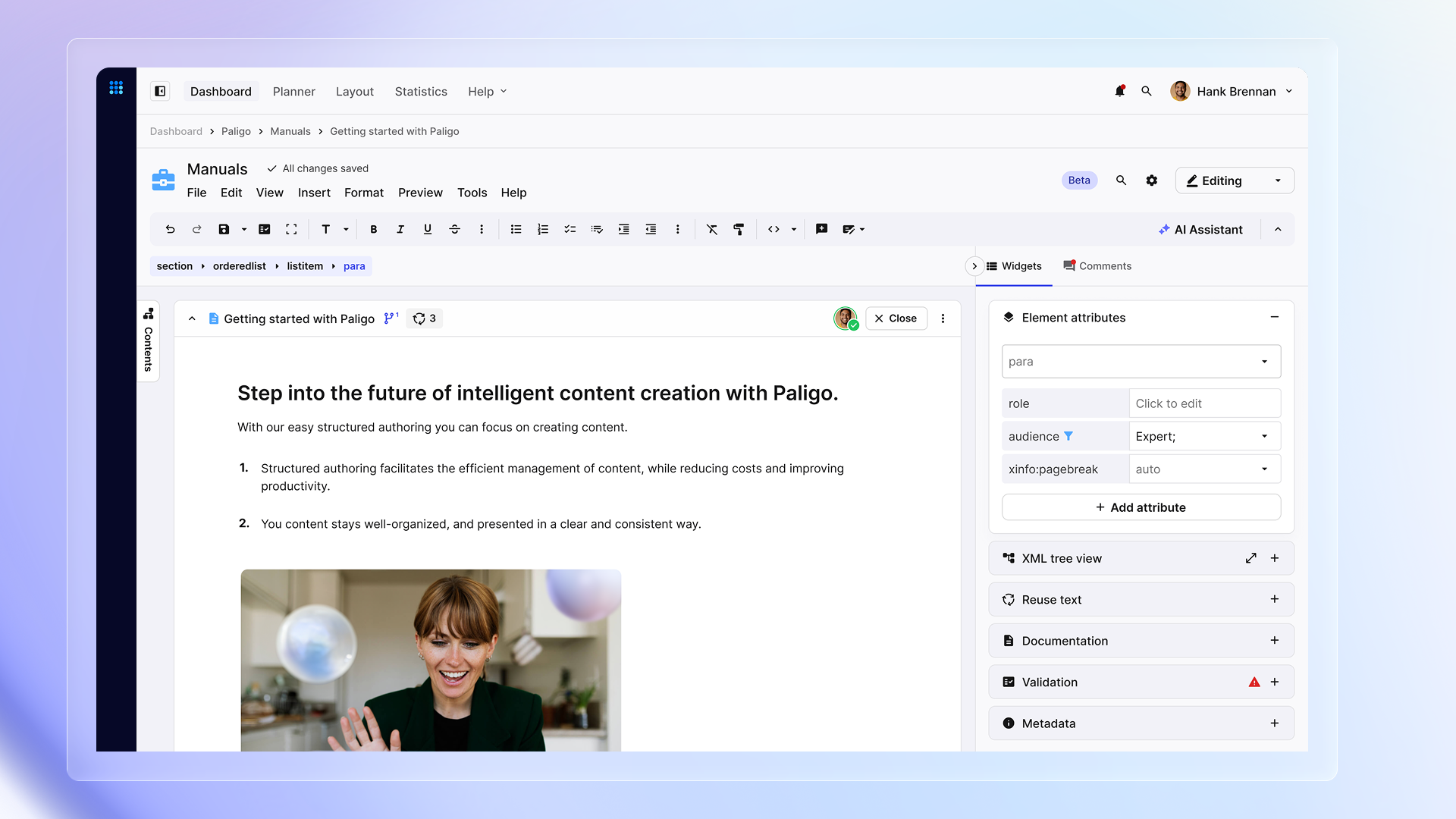
Paligo CCMS is a structured authoring system with an intuitive interface for creating publications and topics. Content is tagged to facilitate categorization and organization, and help authors easily find content to reuse across publications.
If a reused topic is updated in one place, those changes are applied everywhere it’s used. There’s no need to manually update the content in different publications—Paligo does the work for you.
Collaboration and Version Control
Because creating technical documentation is often a team effort, Paligo includes collaboration features that allow authors, editors, and subject matter experts to easily collaborate on authoring, reviewing, approving, and publishing documentation.
Version control features ensure that every change to the content is documented, allowing teams to track changes over time and roll back to previous versions if needed. Version branching enables the documentation team to create a separate copy of the documentation to apply changes that shouldn’t be published immediately—such as updates for new features or fixes to issues that haven’t yet been applied to the product.
Translation Management
Managing technical documentation in a single language is one thing. Managing it in multiple languages is another.
Paligo CCMS provides translation management capabilities that enable teams to create content in one language and send it for translation to third-party translation providers. What’s great about this built-in translation capability is that you only need to translate a topic once, and the translation is applied everywhere that topic is used. This approach means lower translation costs and faster translations.
Integrations with CDPs for Publishing
Paligo CCMS allows you to publish documentation in various formats and on different channels. It supports XML, HTML5, PDF, Word, and more, so you can publish content in any format you need. It also includes built-in integrations with CDPs, including Zoomin, Fluid Topics, and web hosting platform Netlify.
Three Content Delivery Options with Paligo CCMS
Paligo CCMS provides several out-of-the-box integrations with CDPs. Let’s take a quick look at each.
Fluid Topics
FluidTopics is a content delivery platform that ingests technical and product documentation, unifies it, and delivers it to channels such as documentation portals, unified knowledge hubs, and in-product help. The platform includes a built-in documentation portal and knowledge base.
Paligo CCMS is directly integrated with Fluid Topics, giving companies a single-source, structured authoring environment where tech docs teams can create technical content and publish it directly to the CDP. The integration streamlines content creation and publishing, allowing writers to focus on producing clear, concise documentation.
Publishing content to FluidTopics is straightforward, with options to publish entire publications or individual topics directly from Paligo. The integration utilizes HTML5 output, allowing for dynamic content delivery through filtering, profiling, and variables. These capabilities enable personalized experiences and targeted documentation delivery for specific audiences, markets, or products.
Zoomin Software by Salesforce
Zoomin is a data governance and LLM readiness platform that ingests enterprise knowledge from multiple sources and delivers personalized and secure documentation to every customer touchpoint—documentation portals, knowledge bases, and in-product help.
By integrating Zoomin with Paligo CCMS, technical documentation teams can seamlessly create and deliver technical and product documentation to multiple channels. The integration offers flexible publishing options: publish complete publications or individual topics, converting content from XML to HTML5. Paligo taxonomies can be published to Zoomin to support search and categorization.
Advanced features include filtering and profiling to target specific audiences and using variables for dynamic content display. The combination of Paligo’s structured content management and Zoomin’s intelligent delivery creates a comprehensive solution for managing and delivering technical knowledge.
Netlify
Netlify is a web hosting platform enabling developers to quickly create and deploy front-end web and mobile experiences. Through direct integration with Paligo CCMS, developers can access consistent, up-to-date technical documentation to publish to Netlify-hosted websites and web applications.
By eliminating content silos and automating the publishing process, Paligo frees up valuable time and resources. Content creators benefit from a structured authoring environment, simplifying content creation and enabling efficient reuse.
The Netlify integration offers flexible publishing options, allowing you to publish entire publications or individual topics as HTML5. You can target specific audiences with filtering and profiling, personalize content using variables, and manage translations.
Paligo's Netlify Integration Explained
Discover the benefits for your team and your organization when integrating Paligo with Netlify.

CCMS + CDP = A Unified Approach to Multi-Channel Delivery
Your customers expect seamless access to information across many channels—from knowledge bases and support portals to in-app help and AI-powered chatbots. Meeting these expectations with traditional methods becomes increasingly complex and inefficient.
A Content Delivery Platform provides the crucial link between your content and your audience, acting as a central hub that aggregates, structures, and optimizes content for delivery across all channels. By leveraging a CDP, businesses can ensure consistent, accurate, and up-to-date information reaches their customers, regardless of the channel they choose.
But a CDP is only part of the equation. To truly unlock the potential of multi-channel content delivery, a Component Content Management System like Paligo CCMS is essential. Paligo provides the foundation for creating, managing, and single-sourcing your content, ensuring consistency from the start.
When combined with a CDP, it empowers your team to create high-quality, consistent content that flows seamlessly through your delivery pipeline. This combination streamlines workflows, reduces costs, and ultimately enhances the customer experience by providing the right information at the right time in the right place.
FAQ: Common Questions About CCMS and CDP Integration
We already have content in Word, RoboHelp, and our help center. Can we migrate it?
Yes. Paligo provides migration tools and services for importing existing documentation from various formats, including Word, PDF, and legacy systems. Most organizations complete the initial migration within the first few weeks of implementation.
How long does it take to get up and running?
Implementation timelines vary from 3-6 months, depending on content volume and integration complexity. Most organizations achieve initial publishing within 8-12 weeks, with full productivity following shortly after.
Will our writers need to learn XML?
Not really. Paligo hides the XML complexity behind an intuitive editor. Writers focus on content while the system handles structure. Most teams become proficient within 2-4 weeks and reach full productivity within 6-8 weeks.
How does this help with AI readiness?
Structured XML authoring creates optimal content formats for AI training and retrieval. When your content is consistently tagged, formatted, and organized, AI systems can provide more accurate and relevant responses to customer queries.
What kind of cost savings should we expect?
Organizations typically see significant reductions in content creation and publishing time by eliminating multiple tools, reducing manual labor, and improving content reuse efficiency. Translation costs also decrease when you only need to translate each topic once.
Ready to transform your technical documentation workflow? Paligo CCMS provides the structured authoring foundation your organization needs for effective multi-channel content delivery.
Get started with Paligo
Paligo is built to meet the most demanding requirements, with plans made for any company from the growing SMB to the large Enterprise.
Stay ahead in structured content
Get the Paligo Pulse once a month.

Share
Author