
Back to Webinars
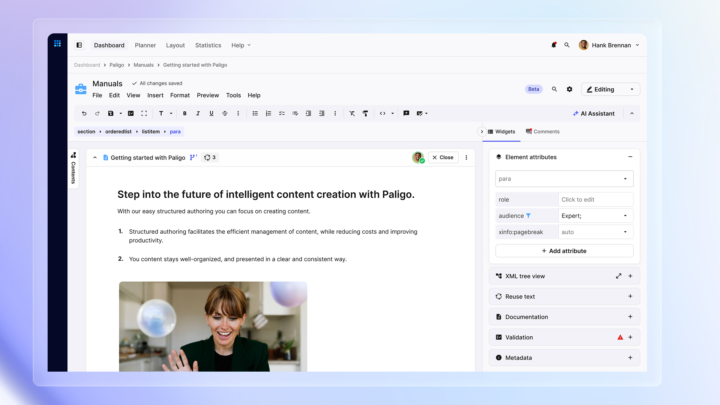
Okay. Yeah. Welcome to everyone who just joined. Welcome to, solving the contradiction of writing efficiency. And I think everyone who writes professionally is pacing some challenges at some point in time. So today, we are going to see which challenges the Aclients you ex team pays, which opportunities developed out of these situations. And, we will get some insights how the Aclients you the writing team works. So stay tuned. And, yeah, let's first have a, short round of introduction. I'm Art Kunlein, and I'm solution consultant to tacklingings. And, Terry, please. Yeah. I'm, mister Trebaumer. I work as a senior recwriter at Aqualings. We're responsible for all UI tech but also the documentation, of our colleagues, and Madlyn is in my team. Our team. Yeah. I'm Madeline Brennan, and I'm also a UX rider with Stephanie. And as she said, we split our time between tech docs, so product documentation and product strings. So UX Rainy. Josh? Hello. Hello, everyone. So I am Josh Anderson. And I am an information architect working for Polygo and, based out of, the Toronto Canada region. So nice to see everybody today. Okay. So first, have a look at what actlings is. So actlings increases efficient see through the content supply chain and reduces the risk of non compliant content. So actlink helps with enterprises with editorial efficiency, risk, compliance, and brand experience. We ask our customers about the value it provides to them and here are some ex examples where they responded. So to reduce the review cycle from three weeks to two days, which is a efficiency gain of ninety percent. It sell saves, three million on fines or it decreases, thirty per percent of the call center volume. Josh, can you please tell us a bit about Palingu? Absolutely. So Pligo is an end to end component content management system or a CCMS solution. And it's especially well suited for technical documentation, as well as things like policies and procedures and knowledge management articles as well. And so we use an XML based structured authoring paradigm, which we use to keep your content accurate, and, up to date and consistent and as future proof as we can. So Plingo provides topic based authoring and smart content reads features. And the idea behind this is that it should enable you to dramatically cut down on the amount of time that it would take to release your documentation. There's multi channel publishing so that you write your content just once, but then you can repurpose it at the click of a button to the output format in the channel that you need, you can make use of, like, variables and profiling attributes to make variations of your content for when the context calls for it. And you can easily bring in a team of authors and contributors and reviewers, even translators to work together in the cloud based league of platform. And thanks to the fact that it's accessible in a browser, our authors can take advantage of Acralinks while they're working in Polygo. Yeah. So let's, first have a look at the processes that, the UX writing team had in place in two thousand twenty two. So where did you start? So in twenty twenty two, we were still writing in confluence. So our documentation lived in server. We used Adgerlink's, an Acralinks integration that was embedded in confluence server, and then we published directly to confluence. This worked for us for many years, I have to say, but, it became much more challenging as the amount of content we were creating grew. And then, of course, that year, we also found out that confluence server was going to be discontinued. Which means that the tool wasn't going to be supported, and, we were going to have to find something as well. Find an alternative. And another another issue with the confluence server was that because it was or is a wiki? We kind of had to take advantage of add ons. They were really useful. We we used some grade tools from k fifteen t, but as, as I said, as our team was changing, and then as the the the tool landscape on the confluence side was changing. We really needed an alternative to to a traditional CMS, wiki tool. So we, started looking for a tool that sat satisfied our use case where we wouldn't have to to find a bunch of workarounds, but, where we could actually get everything in one place. And that's kind of how we discovered Polycom. And with the CTMS system, it's much easier to mix and match. This means it's a lot easier for us to, reuse content. That's a big, a big one for us, and it's definitely streamlined the way that we work. Yeah. So, I think, kind of confluence is more like, like a CMS system. And, so, Josh, so what what's the difference between a CMS system and a CCMS system? So how does it improve your efficiency? Great question. So CMS is probably more commonly known. That's just a content management system. Whereas, a CCMS is a component content management system. So with a CMS, you're usually managing content at the level of a page. And a lot of CMSs are web based, and they'll let you publish right to the web. So think of, like, WordPress or Dhruple as examples of that. But with a c CMS, you can manage your content at a much more granular level than you would be able to with a web CMS. So you can go down to the the paragraph or the phrase, even the word, and a CCMS will let you write these small components and then later assemble them into the publications as necessary. And with a smart content strategy kind of underpinning everything that you do, The same content components can often be used in multiple publications. So when it comes time to publish, the CCMS lets you publish to multiple output sources you know, such as print or web, XML help centers, chat bots, and more. Now I think the reason why a CCMS in particular, gives you really big efficiency gains is because it works well as a single source of truth that lets you reuse the content. And reconfigure it instead of needing to keep creating new pieces. So you mark up your content with variables, with profiles so that you can hide or show certain parts of it as needed given the audience. And then finally, thanks to the fact that CCMS use a structured authoring paradigm. It's much easier to programmatically apply systematic changes across the whole set of content than it would be if you were working with, unstructured content in an unstructured CMS. So Ralph, now that we know what a CCMS is, I was wondering if you could tell me about how Acralinks improves our efficiency and quality, while keeping the risk low. Sure. So, in the center of of Eversing is the enterprise style guide or the the content style guide, of of our customers. And, so Aclink digitalize those. And, that also includes kind of terminology that can be, transferred into our internal, terminology base or cert target systems that we can work with. And, so that's that's really in the center of of, our guidance. And, we make it actionable. So, let's have a look at the auth ring, on the left side. So act length helps, yeah, there with the orsering. And, of course, as earlier as you prevent or fix issues, the last, you have to take care later. And, the more efficient you gain, and cost saving relate fixing post publishing could, could be hundreds or thousands of dollars. Or if you look at, at a risk, side and compliance side, it could be even millions of dollars that you have to spend up if you if you do a post publishing. So, there's really a big gain that you can get if you if you pick them right away while also ring. And, Actlink helps you there to align and to align your your content with your content side guide and, really helps its actionable guidance and, suggest how to to fix or rewrite content. And in a lot of cases, it's just one quick way to solve, to solve the issue. And looking at the editor it editor editorial, aspect, Aglink helps with automated content governance, and, you achieve that by implementing quality gates and so you can ensure that your, content is aligned with your content guide before it reaches the next step in the workflow. This is especially important before you hand over your content to translation, for example, or before publishing. And so you can ensure that your content is on good quality. Now, of course, if you identify issues, then, Aclin helps you with the assistance, fixing those issues like you you're used on from the authoring. And if you look at the content supply chain, then your your process is already, covered now with those two aspects. But if you look at the full life cycle of content, then, yeah, they're you want to do more. And that's where appian's analytics integration hooks in. And, so what what do you do if, if you have existing content and your style guide changes? How do you do you realize that? What if external factors change like a product debt renamed or, a term can't be used due to legal reasons anymore? So, Acclyn's analytics, and creation helps you to identify those problems and, of of the entire organization. And helps fixing them on scale. So especially if you look at further AI applications, then you need to make sure that, you don't train your content on bad content. So or your your AI and bad content. You really want to to ensure that you select the best performing content and, train your content on that. So, Stephanie and, Madeline, as you're working for Aglink, I think it's it's clear for everyone on the call that, you're using athletes to, to ensure that, that quality is good. But people on the call might already have guessed, that, yeah, in two thousand twenty two, you selected Palingou. So as the CCMS Why why it if you selected polling loop? So, yes, we were, like, based on our situation, we were looking for a lot of, different tools. And, we also, have a lot of documentation for our Aqualinks in place as Equalinks is a complex, tool. So, we also needed a solution to structure our content better. So it became clear that we would need a CCMS to really structure our content. We also wanted to have something that was designed for our use case, and very flexible and configured to whatever we might need in the future. And with public, we found this. What we also, of course, had a look at that we could work with Aclings because we're checking our content with Aclings. Course. So we found that, public works with the outgoing browser extension. So that was definitely, a decision appoint, and we also really, thought that publishing to different places and having the option. To publish in HTML as a PDF, whatever we might need in the future is possible, was also a big plus. Because we had to, decide quickly on a tool and also, wanted to make fast, movement, the onboarding help and the support Polygo. Offered was also one point that made a decision. So, yeah, and And to summarize it, Polygo was just the best tool for our needs. What also was a good a big plus was the simplest of usage. So the UI was very helpful. We have to, like, what you see, what you get better. It's really all in one place and thought through. Awesome. So I'm curious about, the process for introducing Plego. Can you tell me a little bit about that? So, yeah. So we had really to have, like, we had only six weeks for the content migration because the conference instance was being shut down. So what we did and this is maybe not the best example of how you wanna do it. We just kind of moved, our content into Polygo. We didn't really have a a good structure yet. And, the good thing is that Polycom was so easy to use that we didn't have trouble. It's just to kind of creating articles, getting our content in there. Uploading, downloading whatever was needed. We did this in, like, six weeks. And then afterwards we started to, like, sort and give everything a structure and rearranged content and rearranged how we, also publish our content. We publishing to Zendesk at the moment. So we also had to set up that system for us to work. That's kind of what's the process. And given all that, what is the the current state of your implementation like? Yeah. So we're using it now for about a year, and it works pretty well. We still building the structure or building a better structure. We learned a lot in this year, also about our content and what kind of content, we have and what we wanna have in the future. We also still, the publishing process is so much easier, but we still, want to look more in automation of that. So, yeah, overall, it's been, good experience, but we still I think there's still some potential for us. Yeah. I'm looking at your current processes. Kind of how how do you use aqualings, with with Palingo out your process? Concentration? Yes. So currently, we write, in Polygo, and then, we check with the head collins, whatever we write. So this is Either way, during the process during the creation of an article, after the article is finished, like, checks in between whenever we feel we need we need that calling We use it. Then we, do a peer review. We have a small team, so we review each other's work. And we have our own quality gate, which means, we don't want to have content content that scores below eighty five. This is something we, of course, over to, write during the checks. So, yeah, usually after, we pass the the test and the recordings checks, we translate or let the translation, create a transition assignment for a translator, we publish in English and German. And after that's done, we publish to Zendesk. And then there is a final review, from our QI team, for functional, yeah, it's a functional review. And we also monitor, our, content for data links. And, yeah, you're you're writing about actlings, but you're also using actlings. So what's what's a well that adds act that accolades adds to your process? I think, the most obvious value is efficiency. Stefan and I are a two person team. And we write product content, all product content, as I mentioned earlier, technical documentation and and product strings so that the tech in the software itself, which means time savings always, are a must. So with Acralinks, this is super easy. We know that we're always checking with the same criteria. And then, of course, we're really excited to see the potential that GenAI offers, in the future as well, because I think this could be a huge help for us. But then, of course, for smaller things like terminology, I know companies have a lot of it. So this is really helpful for for making sure that we're always using the same terms. And then, since we are acrolynx and we we do create a product that is about setting standards. We of course should, should, you know, do that ourselves. So that's That those are the the main things that, Acralinks does for us. Yeah. And can you can you show us kind of highlights, with working with Polyngo and echo links? Yeah. Sure. If I can go ahead and do that. See. If I can find support. Okay. Just a minute. Okay. Can everyone see my screen? Yes. Yep. I think so. Perfect. Thank you. So so yeah. So this is an example, or a demo system where we've prepared some content to show you how we work in Polygo. So this is an article. Let's say I've just written this. I haven't sent it to Stephanie yet for a final review, but I wanna review it myself. Just to make sure that it meets our standards. So I will go ahead and open the Acralinks sidebar. You can see, I clicked on it here in the browser. It opens right next to to my legal window or to the to the authoring environment. My name is click check, and I have score of eighty four. So Stephanie and I, the the quality the manual quality gate that we set for ourselves is an eighty five. This is, based on, the this trial standards that that we've created in acralinks, and this already is showing me a few things I can fix. So For example, I use no brainer. This is an overuse phrase. It says, may be hard for people to understand, so I can go ahead and remove that. And then you can see here that we have the term sidebar, but I haven't capitalized it anywhere. So, this is something we've agreed that needs to be capitalized and I can quickly make sure all instances are capitalized and I misspelled content, so we can go ahead and fix that as well. Let me go ahead and check again It's good, but there's still another term that I missed. I fixed that, and we should be back at a ninety five. So this is great. One thing that we usually do when we write though is we since this is a CCMS, we usually reuse content. This is really helpful for us just to make sure that, this is really helpful so we can author at smaller components. And I want to add an article you see here, check out the selection of your content. I wanna add one more snippet to this particular article. So I'm gonna do that. And you can see I've added it here. But I wanna make sure that my score hasn't gone down. Sometimes, you know, I've I've only scored this this first page, so we need to see Uh-huh. So it did go down a bit, which means there are probably some things I need to check on. You can see, in this case, this little lock icon indicates indicates that there are issues detected here, but that I can't offer them quite yet. So I do need to go back and save first. But I also am going to open this other piece of content and make a couple of changes to make sure our score is just as high as it was before. So I'm using a lot of passive voice here. I'll just quickly change that. You can see I've also not capitalized sidebar. This seems to be a problem that I have, and the last one is also passive. Okay. So I've fixed it all. Now this score is a ninety five. Let's save it and see how our main page of content is doing. Here. One more check. And we should be at a ninety five. There we are. So this meets our standards. Usually when when once a content is a piece of content has has has reached the score we want. We'll go ahead and put it into well, I'll give it to Stephanie for review, but we won't do that today. I'll just show you how I put it in a publication. You can see here I've already created demo publication. So all I have to do is drag this page, which includes these two articles into this publication, and it should be saved. And you can see here just in case you didn't you you wanna make sure you know what's what's included in this article, the the check selection page is here as well. There we go. I'll go ahead and save it. And Stepfi, I think you wanted to share a bit more about the, our templating process and and how we've changed the way we work with Palego? Yes. Exactly. So what, what Palego made us do, and that's a good thing. So before we, we were, like, creating documentation feature based, which means the feature would kind of shape the structure of the content we would produce. But for documentation, this doesn't work really good, and it gives a lot of could lead to confusion and it's not clearly structured. So with a component focus tool like Polygo, we, really thought how we create and structure content. And we decided to, structure content more, on the learning oriented, basis. So we decided to focus on content types and just create the same content types for every, feature we wanna document. So for example, we aiming to have quick start, we just saw in the docu in your, publication, for every feature we have so that it's easy for, our readers to know their way around and having, like, an easy access to whatever we show them. For this, we created different templates in, our system. So that with with the structure already in there. So, also, the authoring process is much more easier because we don't have to start from scratch. We already have to structure in the document, and we can just go ahead and fill in, we made our, like, tiny little notes on what should be in there and little remarks what the content should look like. And this helps us a lot to, make a content that is consistent across all accolings, features and products. Trust, is there anything, you want to highlight from from Palingu's side? Sure. And, thanks for showing off everything there, Madeline Stepphy. I like how we can see how, making one component really well written means that all the other topics that use that component will also be well written, at the same time. So great job showing that efficiency. I like that. Plego has a very good, like, user interface for a CCMS. I think this is as user friendly as as these things kinda get. There are, you know, code views that you can go into. But what's great about Pligo is that you really don't need to go into the code view. You don't need to be an expert in doc book or XML or whatever, you can you can do all the features you need to, without needing to, go deep into that stuff. I think pligo also excels with its efficient publishing. Once we've created the publication, it's only a couple clicks to be able to publish it into say HTML or PDF or, SCORM if you're doing e learning Microsoft Word and so on. Our layout editor, I think, goes a long way in helping users be able to you know, see their designs reflected right away, kind of like, what you see is what you get kinda deal. There's a preview editor as you're working on your layouts, which is very helpful, I think. We also have pretty good translation support integrations with language service providers like phrase and semantic You can export and import your own XLift translation packages. But we've got many integrations, and there's always more being added. So yeah, I think, plea, excels in those ways. Okay. Yeah, let's let's have a look at, the Aclings analytics and creation part. So I'll select the right screen. Here we go. Can you see my screen? So Sure. Here you see, one part of the Aclin's analytics. And, so what you see here is, a scan or check of our Aclin's block. And I selected the, the the block because it's kind of special content. So if we if we check the the documentation, then you know kind of it's already on a good good shape and, we're we're checking it. But as a block is a bit different, So it's marketing content, as a first thing. And in a lot of cases, we write about linguistic for example, so we highlight on issues. So there are issues in for sure. We also, partner contact content there, which is, probably not, kind of hundred percent aligned with our style guide. And, their transcripts of of interviews in or or something like that. So, it's another example here to to show our capabilities. And, yeah, so let's have a have a look into it. So you see the block here. You see color coded from, kind of red to green, the echoing score. You see here is the goal. So you can show the overall action score, or you can also select, a single, aspect of your content. So, for example, if we look at inclusive language, you see a couple of, issues popping up. And, so now you might be wondering, okay, there are a lot of documents where do we start? And that's where, the performance effect comes into. For example, here, I can pull in Google Analytics data and, I pull in, page views. And I see already on good pages, whereas inclusive language, we don't have a lot of issues. But you see, for example, here, there's a, a rat bar, which is quite high compared to the others. So that's probably something that you want to focus on. So let's have a look on it and, look at, as detailed, and you see kind of, here that it's not as bad as it looked, first, because, we're echoing that we're aiming for inclusive content. So, we changed kind of the, scoring in a way that even kind of something below a certain threshold is even still red. And because we really want to avoid, void that. And, you also see here, for example, there are some clarity issues, and that's something you can, dive into. But let's focus on the inclusive language. And if we switch here to the issues, you see directly kind of what was written. And kind of how you should, change it. So, for example, here is a phrase that was found And here, is a suggestion how you should rebride. And if you're a new authoring environment, you would have, suggestion with a click. And you also can get some guidance why you should avoid that writing. And, kind of fun fact, the article that you see here is a blog post about exactly the topics that you were should avoid, that part of content. So that's why it came up. And that's also why we cannot correct it because, kind of, Otherwise, yeah, the article would not make any sense anymore. But, looking at that example, you probably, if it would be a real example where you really identified issues, you, would just go here and say, add that to my review list. And, then it's, added to the review list. You can look at the other examples and identify if it's real issues or not. And later on, you can go to the review list and have a list of all these, items and, you, air can fix them and attract them. Looking at other, things kind of, yeah, if you look at generative AI, you I already told that you you want to focus on the best performing content. So, if we look, for example, post visits, you can see here, kind of which content performs well and has a good quality. And you can also see which content, does not perform as well and where where you should not train your content on. So two aspects. One is the creation part where you really kind of focus on how to, yeah, improve and, and schedule that. And the other part is, kind of identifying the good content and used for whatever AI purpose you have, and there are also, Aclin's AI capabilities that are coming up soon, we're shortly to to release, there. Yeah. So, yeah. So, what's, Maryland, Maryland three And, Stephanie, what's what's the experience after after one year, using a Polyango and backlinks? So I I'll start. Yeah. It's it's been, great. It works really well for us and and meets our needs. I kind of touched on that a bit, and there's still a lot of potential that we haven't used yet. So one of our biggest, as I mentioned, bandwidth is an issue. We we are a small team. So one of the things that's really exciting to us is the potential for automation in Polygo. There is an API, and we're hoping to to make use of it in the future, but we aren't quite there yet. But we you're already working with some developers on our company to help, to help figure out how we can make some automation happen. And then in general, the way Polygo is is is moving as a company really aligns with us. We're both focused on growth. And, we're both ISO certified. So so even even the procurement was really easy for us. As Jeff mentioned, we could we could really get started with the migration quickly, and and it it's been a good relationship so far. Yeah. Awesome. So I can add a a couple things from my side. I think that, Pligo is a really good fit for a lot of companies because of its enterprise readiness. As mentioned, it's ISO certified, and so that physical infrastructure is provided by Amazon web services, data centers all over the world. Pligo is scalable. It's one of the reasons why is because you can have multiple authors working on content at the same time. You know, that component, architecture means that each different author can be working on something independent, and then these things are assembled together later. But it's also scalable in the sense that it's cloud based So, with the legal, you can be confident that you'll be able to accommodate either increased content volume or visitors without compromising your, performance. So I would say if the peep if the features of Pligo have peaked anyone's interest, you can definitely reach out to our team at pligo dot net slash contact We'd love to meet with you to discuss your content, possibly offer a demo, and then work with you however we can to make your content the best it can be. Yeah. And, same with Zachlings. So, yeah, as as I already said, we're also either certified, and, yeah, you'll see we work with, polling Google pretty well. So, yeah, ready. It's ready to use solution. Yeah, let's have a look at, at the questions. So there is one question, if Paulango works with dealer content. Josh? For you? Yeah. Good question. Polygo is based on doc book. So the legal does not work with data content. However, you can import data content and we can help you convert from data to the, docbook based XML structure that you would need, but, no, is the short answer for that. And, yeah, let me have a look if there are more questions. You can still use the, question panel to, to ask questions. So there is another question. As a technical writer, I already have strict editor guidance and compliance requirements based on my everyday work practice. Why would I need actlings as an additional layer of technology for my documentation. So, maybe I take that. So, yeah, so Aclings really helps you to ensure enterprise wide that, you you meet your your quality standards that you implement your, your content, enterprise content style guide and, that, helps you to to really increase efficiency. And, we we often have kind of this, this picture of having kind of a coworker, reviewing your content while you're answering it. I think that's really something that, that improves, cycles where previously, you have to to wait, maybe days, maybe weeks for feedback and where you get really instant feedback, and, it really kind of scales with your entire, organization. Okay. There's another, question. In polling though, after you set up the contribution review, does it work well in the review view for your re reviewer? So I think the questions around, like, the contributor view and the reviewer experience and how that all goes. Definitely. I I think it is a a good experience, a good interface. There's different interfaces for the different roles Flego. So if you're an author, you get kind of all the options, and then there's a contributor view, as well as a a reviewer view. And these things have different, you know, price points. So depending on your team, you it might make sense to have a different number of people who are only reviewers versus authors and so on. And, yeah, so reviewers are able to read the content and leave comments, offer feedback, contributors are able to see just the content that's pertinent to them. They're they probably won't be the ones managing the the content manager or setting up the variables and managing the images or whatever. It's really kind of focused on writing for them. But then the authors, yeah, have all those options. So, yeah, I I'd say definitely if you're in if you're more interested for a hands on, look, please reach out to us. We can meet with you. We can demo these things and, answer all your questions there. And, there's another question, that I gonna take, and, I'm gonna take it in, showing it. So, actually, I got or we got the question, our team of medical writers has over climate for Flash can say the grade level scores, and, if if they can get that through accolades. And, the answer is a clear yes. And, maybe we just, use the example from before looking at, the documents that we already have seen. And, if we look here, add a scorecard that is present in every integration, and we also have, that information in, in the Cypher and newer versions of actlings. And you see here, for example, that optical, reaches level six. And, you can really kind of have instant feedback if you, if you go and type or correct your issues and, get an updated view on that. Okay. Another question. So what kind of changes to the writing process might or us need to make to in order to best use Palingou and Aqualins. Sure. Yeah. I can take this. So I think that The fact that Polygo is a component contact management system might be a paradigm shift for authors in a way, especially if authors are used to something like Microsoft Word or Google Docs where The the presentation and the content are so, like, tightly intertwined, oftentimes when authors are creating something and Google docs or whatever, they're they're writing the words, but they're also highlighting it and determining what color it'll be and what font size it'll be and all that stuff. So the paradigm shift that you would need moving to a system such as Polygo would be to know that the content in the presentation are independents. You're working on the content, not knowing necessarily what it will look like by the time the the reader sees it. Because if they're viewing that content on you know, a written page. It's gonna be different than it would be on a cell phone screen or on a smartwatch or on a tablet or whatever. And so, yeah, sometimes there's some growing pains associated with, like, we're tagging our content not as how we want it to appear, but, like, what is the semantic meaning behind it? So I don't give something bold, but I give something as title. And then later, I I say title should be shown as bold or whatever. Things like that, I think, would be, a paradigm shift that might be necessary for authors going into that structured authoring environment for the first time. Well, I think that's kind of helps across everything. So an act link is also, it's important to identify if something is the title. Or if something is, plain content because you write different in the titles. So you probably apply AP style or Chicago style content, titles and you don't have a full stop at the end of the sentence or or at the end of the title. So, it's really also important information for accolings present in Palingo. Yeah. So, yeah. And another question, is it easy to migrate content into Palingo. And I think that question was mainly already answered because, kind of you did it within three weeks. Sure. Yeah. So as we've heard, it can be done quick. I would say this is one of those questions where the answer probably depends. If your content starts off in a structured XML based format, it'll be much easier for you to migrate your content into Polygo than it would be for somebody going from, like, PDF or Microsoft Word or something because those things are not structured. So there would be this this first step of, like, get your content into a structure and then move it into Plego. But if you use something else that is structured, but isn't quite the same docbook that Polio uses. For example, if you're using a Didda or s one thousand d or markdown or all these other formats. Yeah, we can work with you to bring those over. There'll probably be some work, some cleanup involved in making that migration. So, you know, it it won't happen instantly, I wouldn't say, but it can happen, quick with our team's help and definitely eager to, help you out making that migration. And another question, would the content content component management like you're talking about here, Palingo, be useful to any teams outside of technical writing or documentation. I think yeah. I mean, especially if you've got a a large team, you have many writers. You have many different publishing output needs. You anticipate that you would be reusing content. You have needs for translation. If any of those things are true, then I think Polygo can work for you. It doesn't necessarily have to be technical documentation. Okay. Any further questions from anyone? Giving it thirty seconds. And, yeah, I would say, thank you for the great webinar. And, if you have any questions, please reach out to us. And, yeah, we can go more into details if you if you like having a demo, of two solutions together.